
Picture this common scenario: You take a morning off from your busy schedule, visit your doctor for your annual health checkup, and complete your routine Complete Blood Count (CBC) and standard Fasting Sugar report. A day later, you review the PDF on your phone. The numbers fall perfectly within the green "normal" reference ranges. Your doctor gives you a clean bill of health, you feel a profound sense of relief, and you go back to your fast-paced life in Mumbai.
But what if those basic, routine reports are missing the full picture?
For decades, the standard annual health checkup has remained largely unchanged. We test for basic cholesterol, simple fasting glucose, and generalized kidney and liver function. However, modern clinical pathology and longevity medicine have evolved significantly. Today, we know that these standard panels often fail to detect the very earliest, microscopic biological shifts that eventually lead to chronic, life-altering illnesses.
Standard tests are excellent at telling you if you are currently sick. But they are surprisingly poor at telling you if you are going to be sick. Detecting the earliest signs of insulin resistance, endothelial dysfunction, and cardiovascular disease requires looking far beyond the basic metabolic panel. If you are serious about your healthspan (the number of years you live healthy and disease-free), preventive medicine, and avoiding sudden medical emergencies, you need to understand the next generation of advanced blood reports.
Here is the ultimate guide to the advanced cardiovascular and metabolic biomarkers that are changing the face of preventive health, and how you can access them right here in Kandivali West.
When you want to check your heart health, the default test is the Lipid Profile. This report gives you a measurement of your Total Cholesterol, LDL (the "bad" cholesterol), HDL (the "good" cholesterol), and Triglycerides.
For years, cardiologists told patients to simply keep their LDL cholesterol below a certain threshold. However, clinical data revealed a startling paradox: a massive percentage of patients who suffered from severe heart attacks had "normal" LDL cholesterol levels at the time of their cardiac event. How is this possible?
The answer lies in how a standard Lipid Profile actually measures cholesterol. A basic lipid panel measures the concentration (the weight or volume) of cholesterol carried within the LDL particles in your blood. But modern cardiology reveals that it is not just the volume of cholesterol that causes heart attacks—it is the number of particles carrying that cholesterol.
Imagine a highway (your blood vessels) carrying passengers (cholesterol). The passengers travel in vehicles (lipoproteins). A standard LDL test simply weighs all the passengers on the highway. But heart disease isn't caused by the weight of the passengers; it is caused by the vehicles crashing into the walls of the highway. If you have a few large buses carrying the passengers, the risk of a crash is low. But if you have thousands of tiny, erratic scooters carrying the exact same weight of passengers, the risk of a crash—and subsequent arterial damage—is exponentially higher.
This is why you need to count the vehicles, not just weigh the passengers.
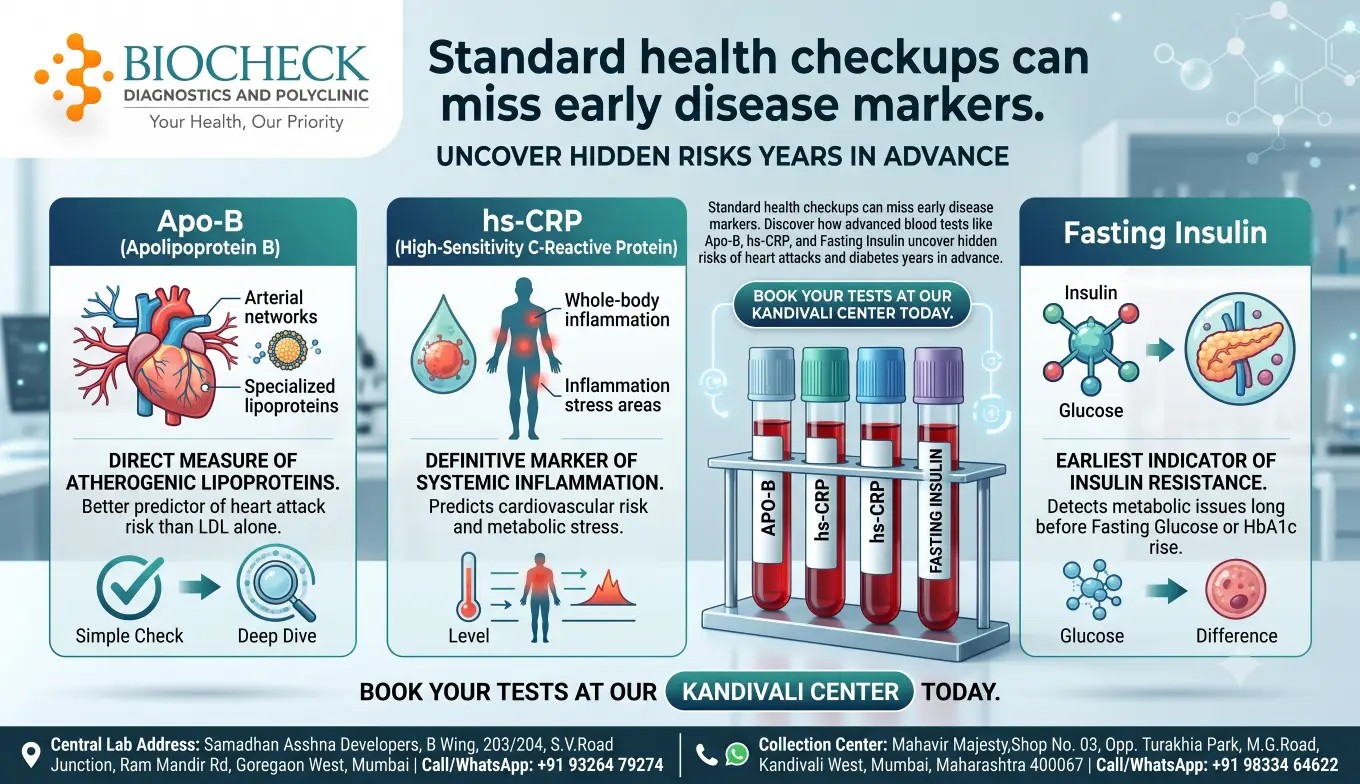
If you want a true, accurate assessment of your cardiovascular risk, you must look at Apolipoprotein B (Apo-B).
Apo-B is a specific structural protein that is attached to the surface of every single potentially dangerous, plaque-causing cholesterol particle in your bloodstream, including LDL, VLDL (Very Low-Density Lipoprotein), and IDL (Intermediate-Density Lipoprotein). Crucially, there is exactly one Apo-B molecule per particle.
By measuring the concentration of Apo-B in your blood, your doctor gets an exact, one-to-one count of the plaque-causing particles circulating in your vascular system.
It is widely considered by modern lipidologists to be a far more accurate predictor of cardiovascular risk than a standard LDL measurement. This is especially true for patients who suffer from "discordance." Discordance happens when your LDL cholesterol weight is completely normal, but your Apo-B particle count is dangerously high. This is incredibly common in patients who consume highly processed diets, have high triglycerides, or are pre-diabetic. If you rely only on a standard Lipid Profile, this hidden, massive risk factor goes completely undetected until an arterial blockage forms.
We have established that Apo-B particles crash into the walls of your arteries, leaving cholesterol behind and forming plaques. But why do they crash in the first place, and why do those plaques suddenly rupture to cause a heart attack?
The answer is chronic inflammation.
Heart disease is not a plumbing problem where pipes just slowly clog up with fat. It is an inflammatory disease. When the delicate inner lining of your blood vessels (the endothelium) becomes inflamed due to stress, poor diet, smoking, or high blood pressure, it becomes sticky and permeable. This allows the Apo-B particles to easily penetrate the arterial wall. Furthermore, inflammation makes existing cholesterol plaques highly unstable and prone to rupturing.
The hs-CRP (High-Sensitivity C-Reactive Protein) test is designed to detect this hidden fire. C-Reactive Protein is a substance produced by your liver in response to systemic inflammation. While a standard CRP test looks for massive spikes caused by major infections, the high-sensitivity (hs-CRP) version detects the microscopic, low-grade, chronic inflammation smoldering inside your blood vessels.
If you have perfectly normal cholesterol but high hs-CRP, your cardiovascular system is under severe distress, and you are still at a highly elevated risk for a cardiac event. Tracking this marker allows you to make immediate lifestyle interventions—such as adopting an anti-inflammatory diet, improving sleep architecture, and managing cortisol levels—to cool down your vascular system before structural damage occurs.
While diet and lifestyle play massive roles in heart health, genetics cannot be ignored. Lipoprotein(a), often pronounced "L-P-little-A," is a highly dangerous type of lipoprotein that is genetically determined.
Lp(a) is incredibly sticky and highly prone to causing both atherosclerosis (plaque buildup) and thrombosis (blood clotting). Because Lp(a) levels are determined by your DNA, they are largely unaffected by diet, exercise, or even standard statin medications. Many individuals who are extremely fit, eat perfectly, and have no standard risk factors suffer from sudden, unexplained heart attacks simply because they inherited high Lp(a) levels.
Cardiology guidelines now recommend that every adult should have their Lp(a) levels tested at least once in their lifetime. If your levels are high, your doctor will know that you require far more aggressive management of your other modifiable risk factors (like Apo-B and blood pressure) to offset this genetic vulnerability.
Just as the Lipid Profile gives a false sense of security for heart health, the standard Fasting Blood Sugar test gives a dangerous false sense of security regarding diabetes.
By the time a standard Fasting Blood Sugar test or an HbA1c test turns abnormal, you do not "suddenly" have diabetes. The biological breakdown that causes Type 2 Diabetes has actually been occurring silently in your body for anywhere from five to ten years.
Whenever you eat carbohydrates, your digestive system breaks them down into glucose, which enters your bloodstream. Your pancreas then secretes a hormone called insulin. Insulin acts as a key, unlocking your cells so the glucose can enter and be used for energy.
However, when you consistently consume a diet high in processed sugars and refined carbohydrates, and lead a sedentary lifestyle, your cells become overwhelmed. They start ignoring the insulin. This is called "insulin resistance." Because your cells won't open, glucose stays trapped in your bloodstream.
Your pancreas panics. To force your stubborn cells to take in the glucose, it pumps out massive, abnormally high amounts of insulin.
Here is the critical flaw in standard testing: Because your pancreas is working overtime and flooding your system with insulin, it actually succeeds in keeping your blood sugar levels perfectly normal for years. If you only test your fasting blood sugar, you will think you are perfectly healthy. You are completely unaware that your pancreas is exhausted and your cells are highly resistant.
Eventually, the pancreas burns out. It can no longer produce enough insulin to overcome the resistance. Only then does your blood sugar finally rise, and your doctor diagnoses you with Type 2 Diabetes.
By testing your Fasting Insulin levels alongside your Fasting Blood Sugar, your doctor can calculate your HOMA-IR (Homeostatic Model Assessment for Insulin Resistance). If your blood sugar is normal, but your Fasting Insulin is sky-high, it is a massive red flag.
Testing your Fasting Insulin allows you to predict the onset of Type 2 Diabetes up to a decade before it happens. This gives you a massive, invaluable window of time to completely reverse the insulin resistance through dietary changes, intermittent fasting, and resistance training, ensuring you never cross the threshold into full-blown diabetes.
Historically, accessing these advanced longevity and preventive biomarkers required visiting specialized cardiologists, booking appointments at massive tertiary care hospitals in South Mumbai, or dealing with incredibly expensive, niche diagnostic labs.
That is no longer the case. We believe that cutting-edge, proactive healthcare should be accessible and convenient for everyone.
With the launch of the Biocheck Diagnostics Pathology Collection Center, located at Shop No. 3, Mahavir Majesty on Mahatma Gandhi Road, Kandivali West residents now have direct, localized access to the next generation of clinical pathology.
Situated right opposite Turakhia Park and nestled within the Gaothan, Pushp Heritage area of Dahanukar Wadi, our state-of-the-art collection center is built to bring premium diagnostics to your neighborhood. You no longer need to navigate heavy traffic to get world-class testing.
Whether you are looking to seamlessly upgrade your annual health checkup to include Apo-B, hs-CRP, and Fasting Insulin, or you are managing existing conditions, Biocheck Diagnostics makes the process effortless. You can walk into our highly hygienic, modern Kandivali center for a quick morning blood draw, or you can leverage our fast and reliable Home Sample Collection service for testing right in your living room.
Every single sample is processed in our advanced, NABL-standard automated laboratory, and your specialized reports are rigorously verified by expert M.D. Pathologists to guarantee clinical precision.
Do not wait for a disease to manifest before you take action. Move from reactive healthcare to proactive longevity. Visit our Kandivali West collection center today, upgrade your blood panels, and take absolute control of your future health.
Available Near You
Whether you’re in Malad, Goregaon, Jogeshwari, Andheri or any part of Mumbai, BIOCHECK Diagnostics & Polyclinic is your trusted local centre for Biochemistry and comprehensive Biochemistry services.