
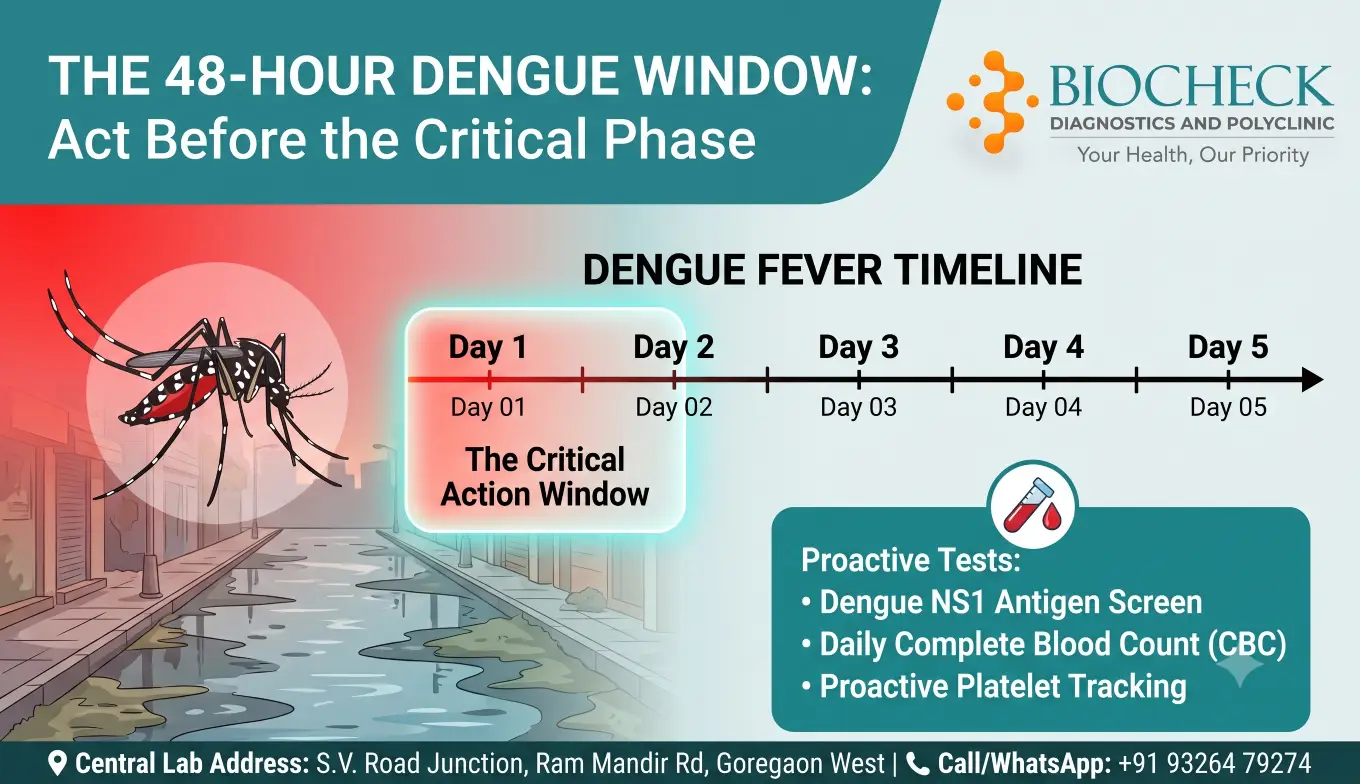
As the heavy July rains create stagnant water pools across Mumbai's western suburbs, the breeding cycle of the Aedes aegypti mosquito reaches its peak. This urban mosquito is the primary carrier of the Dengue virus, making monsoon season one of the highest-risk periods for Dengue infections across the city.
Dengue is not an ordinary viral fever. It is a rapidly evolving infection that follows a predictable clinical timeline and has the potential to cause serious complications if diagnosis and monitoring are delayed.
One of the defining characteristics of Dengue is its effect on the circulatory system. The virus can increase blood vessel permeability and significantly reduce platelet counts, increasing the risk of bleeding and severe illness if left unmanaged.
When a sudden high-grade fever develops, the first 48 hours become extremely important. Early laboratory diagnosis allows physicians to initiate timely monitoring and supportive treatment before the disease progresses into its critical stage.
Dengue infection generally progresses through three well-recognized clinical phases.
The illness usually begins with an abrupt high fever that may reach 104°F, accompanied by severe headache, pain behind the eyes (retro-orbital pain), intense muscle aches, fatigue, and severe joint pain—earning Dengue its well-known nickname, "breakbone fever."
Because these symptoms resemble influenza, viral fever, or early leptospirosis, many patients initially self-medicate without laboratory confirmation.
This is the most important stage of Dengue infection. In many patients, the fever begins to subside, creating a false impression that recovery has started. However, this is when complications are most likely to develop.
During this period, increased vascular permeability may cause plasma leakage while platelet counts can decline rapidly. Careful medical supervision and serial blood investigations are essential to detect warning signs before severe complications develop.
With appropriate hydration, clinical monitoring, and supportive care, plasma leakage gradually resolves, platelet counts begin to recover, and patients steadily improve.
Traditional Dengue antibody tests (IgM and IgG) rely on the body's immune response. However, detectable antibody levels usually appear only after four to five days of illness, limiting their usefulness during the earliest stage of infection.
The Dengue NS1 Antigen Test offers a significant advantage because it detects the viral Non-Structural Protein 1 (NS1), which circulates in the bloodstream soon after infection.
The NS1 antigen is typically detectable within the first 24–48 hours after fever begins, enabling physicians to confirm Dengue much earlier than antibody-based testing.
Early diagnosis allows prompt clinical monitoring, appropriate hydration strategies, and regular laboratory follow-up before the disease reaches its critical phase.
Confirming Dengue with an NS1 test is only the beginning. Effective management depends on continuous monitoring of blood parameters throughout the illness.
A Complete Blood Count (CBC) provides valuable information about how the infection is affecting the body, particularly through two important markers.
Platelets play a critical role in normal blood clotting. During Dengue infection, platelet counts may decline significantly. Regular monitoring helps physicians assess disease progression and determine whether hospitalization or additional supportive treatment may be required.
Hematocrit measures the proportion of red blood cells in the bloodstream. Rising hematocrit levels may indicate plasma leakage and serve as an important early marker of disease severity when interpreted alongside the patient's clinical condition.
Once Dengue is suspected or confirmed, medication choices become extremely important.
Pain relievers such as Ibuprofen, Aspirin, and Naproxen should generally be avoided unless specifically advised by a physician because they may increase the risk of bleeding in Dengue patients.
Paracetamol is generally considered the preferred medication for fever management in Dengue, but patients should still seek medical advice regarding dosage and ongoing monitoring, particularly if liver function is a concern.
During Mumbai's monsoon season, laboratories process thousands of CBC investigations every day. Although automated analyzers provide rapid results, certain situations—such as platelet clumping or reactive blood cell changes—may require expert microscopic confirmation.
At Biocheck Diagnostics & Polyclinic, our MD Pathologists carefully review flagged peripheral blood smears whenever clinically indicated. This additional level of verification helps ensure accurate platelet counts and reliable hematological interpretation for your treating physician.
Accurate pathology supports timely clinical decision-making, allowing physicians to monitor disease progression with confidence throughout every stage of Dengue infection.
When sudden fever strikes, travelling through traffic or heavy monsoon rains to visit a laboratory may not always be practical.
Biocheck Diagnostics offers professional temperature-controlled home sample collection across Goregaon, Malad, Andheri, and surrounding areas, allowing patients to undergo timely NS1 Antigen testing and CBC investigations without unnecessary travel.
Our certified phlebotomy team follows strict sample handling and transport protocols to preserve specimen integrity and ensure accurate laboratory results from collection through analysis.
The first 48 hours after the onset of fever are crucial for identifying Dengue early. Timely NS1 Antigen testing combined with regular CBC monitoring enables physicians to detect warning signs sooner and guide appropriate medical management throughout the course of the illness.
If you or a family member develops sudden high fever during Mumbai's monsoon season, don't rely on assumptions. Prompt laboratory evaluation can provide valuable information that supports faster diagnosis and safer treatment decisions.
📍 Address: Samadhan Asshna Developers, B Wing, 203/204 S.V. Road Junction, Ram Mandir Rd, Goregaon West, Mumbai, Maharashtra 400104, India
📞 Call / WhatsApp: +91 93264 79274
🌐 Official Portal: https://biocheckdiagnostics.com
Available Near You
Whether you’re in Malad, Goregaon, Jogeshwari, Andheri or any part of Mumbai, BIOCHECK Diagnostics & Polyclinic is your trusted local centre for Serology and comprehensive Serology services.