
When the intense July monsoon showers temporarily pause, they leave behind countless stagnant water collections across Mumbai's western suburbs. Potholes, construction sites, discarded containers, blocked drains, and water-filled terraces quickly become ideal breeding grounds for mosquitoes.
Within days, healthcare facilities across the city begin seeing a sharp rise in mosquito-borne illnesses, particularly Dengue, Malaria, and Chikungunya. These infections commonly increase during the monsoon season due to favorable breeding conditions for disease-carrying mosquitoes.
Although all three illnesses often begin with a sudden high fever, they are caused by different organisms, affect the body differently, and require distinct diagnostic approaches. Accurate laboratory testing is essential for timely treatment and to reduce the risk of complications.
Rather than relying on symptoms alone or self-medicating, early pathology investigations help physicians identify the exact cause of the fever and begin appropriate medical management.
Each mosquito-borne illness follows a different disease process because it is caused by a different infectious organism.
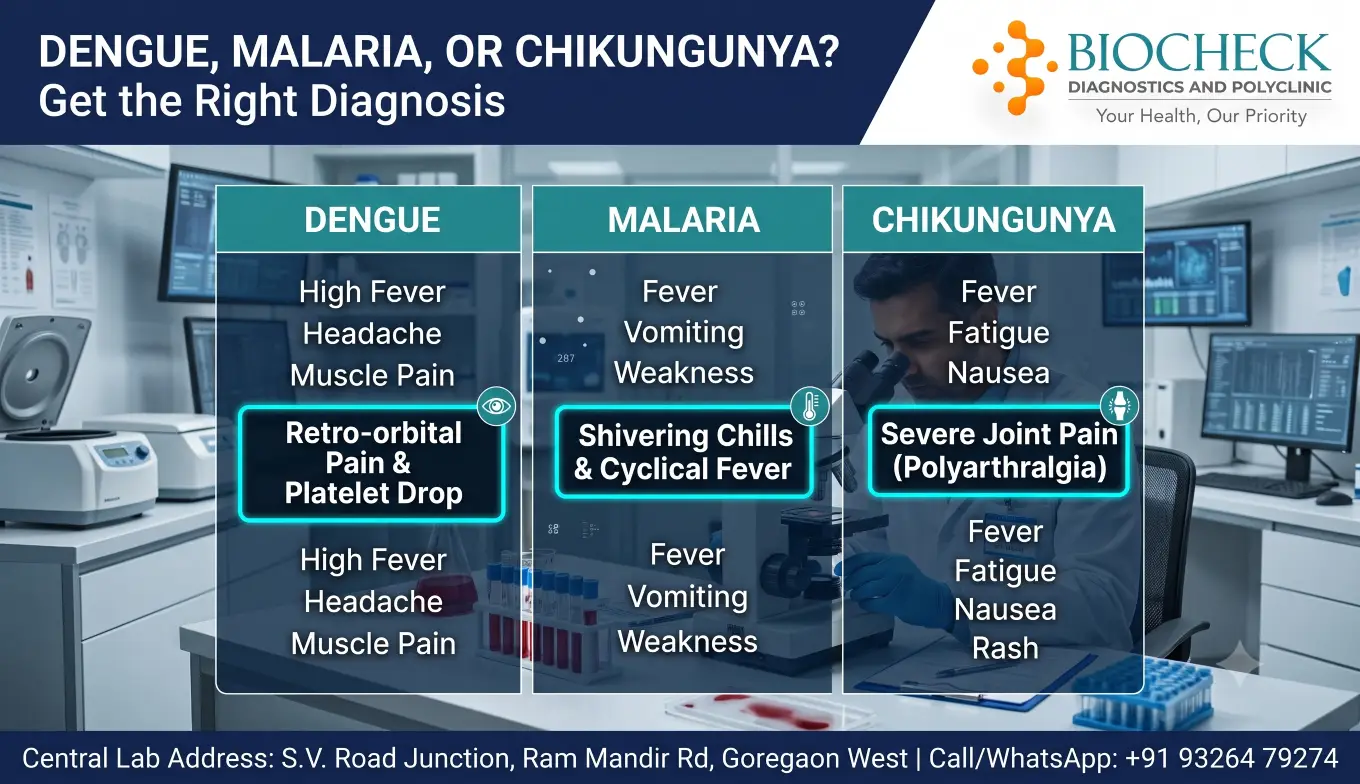
Dengue is transmitted by the Aedes aegypti mosquito, which primarily bites during the daytime and breeds in clean stagnant water. The Dengue virus primarily affects blood vessels and platelets, making careful laboratory monitoring essential throughout the illness.
Malaria is spread by the female Anopheles mosquito, which usually bites between dusk and dawn. Unlike Dengue, Malaria is caused by Plasmodium parasites that infect and destroy red blood cells, potentially leading to anemia and other serious complications if untreated.
Chikungunya is also transmitted mainly by the Aedes mosquito. This viral infection is particularly known for causing intense inflammation of the joints, resulting in severe pain that may persist long after the fever has resolved.
Although laboratory testing provides the definitive diagnosis, understanding the characteristic symptom patterns can help guide timely medical evaluation.
Because the symptoms frequently overlap, laboratory confirmation is the safest and most reliable way to distinguish between these infections.
At Biocheck Diagnostics & Polyclinic, our Monsoon Acute Fever Profile assists physicians by evaluating the most common mosquito-borne illnesses through appropriate laboratory investigations.
These targeted investigations provide physicians with accurate diagnostic information, enabling timely and appropriate treatment decisions.
During Mumbai's monsoon season, overlapping infections may occasionally occur, and similar symptoms can make diagnosis challenging. Automated laboratory systems provide rapid results, but certain blood abnormalities require expert microscopic evaluation.
At Biocheck Diagnostics, every flagged blood smear and abnormal hematology profile is reviewed by experienced MD Pathologists. Their expertise helps identify malaria parasites, evaluate blood cell morphology, interpret borderline laboratory findings, and ensure accurate reporting for your treating physician.
This additional layer of clinical review supports confident diagnosis and helps physicians differentiate between Dengue, Malaria, Chikungunya, and other causes of acute fever.
Travelling with a high fever during Mumbai's rainy season can be both uncomfortable and difficult. Biocheck Diagnostics offers professional home sample collection across Goregaon, Malad, Andheri, and nearby areas for patients requiring urgent laboratory investigations.
Our trained phlebotomy professionals follow strict hygiene standards and use temperature-controlled transport systems to preserve sample quality from collection through laboratory analysis.
Whether your physician suspects Dengue, Malaria, Chikungunya, or another infectious illness, early laboratory diagnosis provides valuable information for timely treatment and ongoing clinical monitoring.
Although these mosquito-borne illnesses often begin with similar symptoms, their treatment and monitoring requirements differ significantly. Prompt pathology testing helps physicians identify the exact infection and initiate the most appropriate care without unnecessary delay.
If you or a family member develops sudden fever during Mumbai's monsoon season, seek medical advice promptly and consider early laboratory evaluation rather than relying on self-medication.
📍 Address: Samadhan Asshna Developers, B Wing, 203/204 S.V. Road Junction, Ram Mandir Rd, Goregaon West, Mumbai, Maharashtra 400104, India
📞 Call / WhatsApp: +91 93264 79274
🌐 Official Portal: https://biocheckdiagnostics.com
Available Near You
Whether you’re in Malad, Goregaon, Jogeshwari, Andheri or any part of Mumbai, BIOCHECK Diagnostics & Polyclinic is your trusted local centre for Serology and comprehensive Serology services.