Kandivali West, particularly the bustling lanes around Mahavir Nagar, is legendary for its vibrant street food culture. From buttery pav bhaji and late-night dosas to rich, deep-fried snacks and indulgent festive sweets, treating yourself is a core part of the Mumbai experience. For many residents, evenings are spent navigating the famous Khau Gallis, socializing over plates of highly processed, deliciously rich local delicacies.
However, this culinary paradise comes with a hidden cost. A diet heavily reliant on refined carbohydrates, saturated fats, and processed palm oils leaves a silent, dangerous footprint on your cardiovascular system. When you combine this diet with the highly sedentary nature of modern corporate life—often involving long hours sitting at desks in nearby commercial hubs like Mindspace Malad or endless commutes stuck in Western Express Highway traffic—you create the perfect storm for metabolic dysfunction.
Heart disease is no longer a condition reserved for the elderly. It is increasingly striking younger urban professionals in their 30s and 40s. The terrifying aspect of high cholesterol is that it rarely presents with physical symptoms until a critical cardiovascular event, such as a heart attack or stroke, occurs. The very first warning sign is almost always hidden inside a routine Lipid Profile report.
When you receive your blood test results and see a wall of red, flagged numbers indicating high cholesterol, it can trigger immediate anxiety. You might assume that you must immediately eliminate all fats from your diet or resign yourself to a lifetime of medication. But not all cholesterol is created equal, and not all fats are your enemy. Understanding how to accurately read and interpret your Lipid Profile is the very first step toward reversing high cholesterol before it leads to irreversible arterial blockages.
For decades, the medical community focused almost entirely on "Total Cholesterol." Patients were told to keep this single number below 200 mg/dL. Today, clinical pathology has advanced, and we understand that looking only at Total Cholesterol is like looking at the total population of a city without knowing who the criminals and who the police officers are.
A complete, modern Lipid Profile breaks down the specific types of fats (lipids) floating in your bloodstream. Your liver produces cholesterol because your body absolutely needs it—it is essential for building cell membranes, producing Vitamin D, and synthesizing vital hormones like testosterone and estrogen. The danger lies in how this cholesterol is transported. Since fat and blood (which is mostly water) do not mix, your body packages cholesterol into protein-covered vehicles called lipoproteins.
Here is exactly what the acronyms on your Biocheck Diagnostics report actually mean:
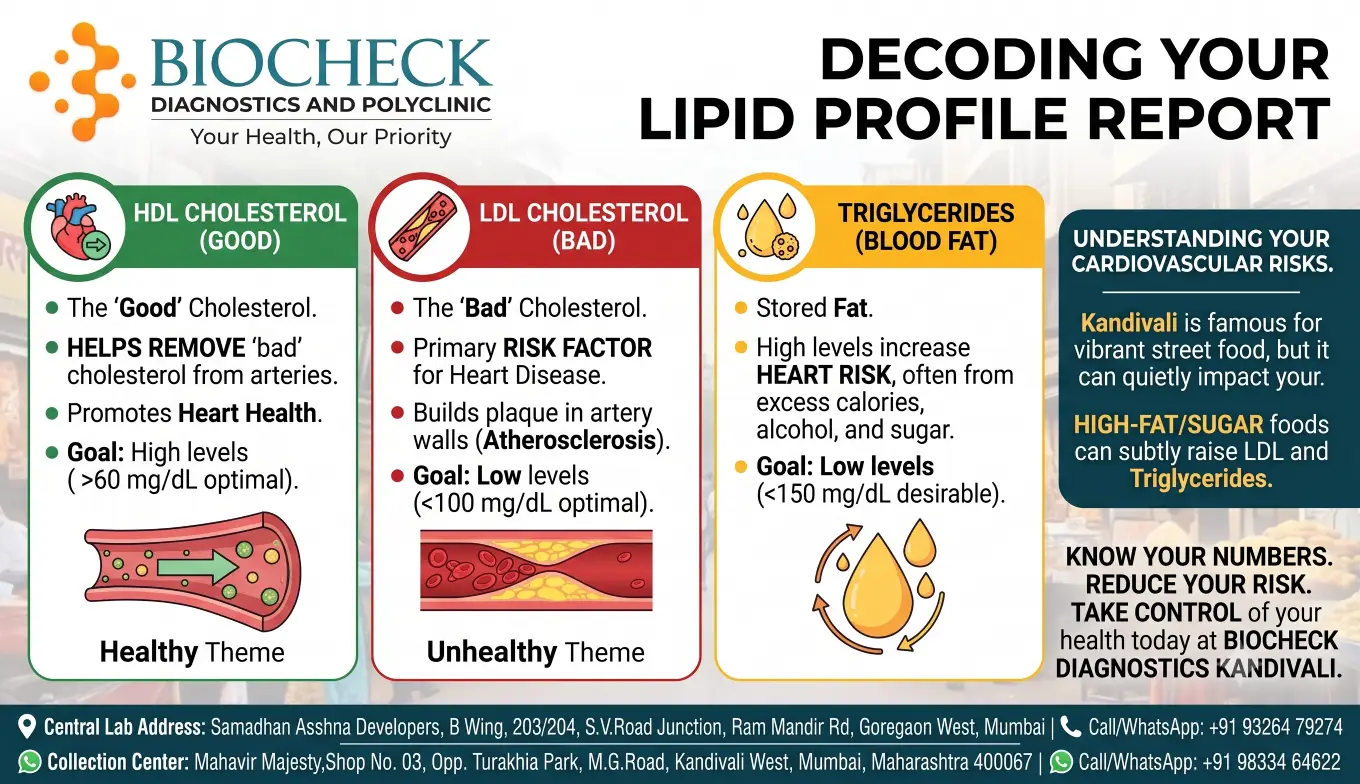
LDL is commonly known as the "bad" cholesterol, but its actual job is to carry necessary cholesterol from your liver to the cells throughout your body that need it. Problems arise when your LDL levels are chronically too high, or when the LDL particles become damaged by free radicals (a process called oxidation).
When there is an excess of LDL in your bloodstream, these particles tend to crash into the delicate inner lining of your blood vessels (the endothelium). Over time, they stick to the walls of your arteries, triggering an inflammatory response. Your immune system sends white blood cells to clean up the mess, but they end up getting stuck too, forming hard, calcified plaques. This process, known as atherosclerosis, narrows the arteries and restricts blood flow. If one of these plaques ruptures, it can cause a blood clot that completely blocks the artery, resulting in a heart attack. You want your LDL number to be as low as possible, ideally well below 100 mg/dL for healthy adults.
Think of HDL as the garbage trucks or the microscopic police force of your bloodstream. HDL particles act in a process called "reverse cholesterol transport." They sweep through your arteries, picking up excess, dangerous LDL cholesterol from the arterial walls and transporting it back to the liver, where it can be safely broken down and flushed out of your body as waste.
A higher HDL number acts as a powerful protective shield for your heart. Unlike LDL, where lower is better, you want your HDL to be as high as possible. For men, an HDL above 40 mg/dL is recommended, and for women, above 50 mg/dL. The most effective ways to boost your HDL levels are not found in a pill, but through rigorous cardiovascular exercise—like taking brisk, sweaty walks around Turakhia Park—and consuming healthy fats like those found in almonds, walnuts, and olive oil.
Triglycerides are a completely different type of fat found in your blood, and they are directly linked to your immediate diet. When you consume more calories than you burn, your body does not just discard them. The liver converts those excess calories into triglycerides and stores them in your fat cells for later energy use.
While fats contribute to triglycerides, the biggest culprits in Kandivali's diet are actually sugars, alcohol, and simple, refined carbohydrates like white rice, maida (refined flour used in pav and naans), and sugary beverages. When you eat a heavy plate of pav bhaji, the rapid spike in blood sugar forces your liver to convert the excess glucose into triglycerides. High triglycerides make your blood thicker and more sluggish. When combined with high LDL and low HDL, high triglycerides create a massive red flag for Metabolic Syndrome—a cluster of conditions that multiply your risk for heart disease, stroke, and Type 2 Diabetes.
VLDL is another "bad" cholesterol, but while LDL primarily carries standard cholesterol, VLDL is the specific vehicle that carries triglycerides from your liver to your fat tissues. Because VLDL is difficult to measure directly, most pathology reports estimate it as a percentage of your total triglycerides. Like LDL, VLDL contributes to the buildup of plaque in your arteries.
While the individual numbers are important, modern cardiologists often look at the ratios between these numbers to determine your true risk. Your Biocheck Diagnostics report will typically include:
- Total Cholesterol to HDL Ratio: This is calculated by dividing your Total Cholesterol by your HDL level. If your Total Cholesterol is 200 and your HDL is 50, your ratio is 4:1. A ratio below 5:1 is considered ideal, with below 3.5:1 being excellent.
- Triglyceride to HDL Ratio: This is a highly predictive marker for insulin resistance and early-stage diabetes. A healthy ratio is typically below 2:1. If your triglycerides are soaring and your HDL is dropping, it indicates severe metabolic stress, often tied to a highly processed diet and lack of movement.
It is impossible to talk about heart health in Mumbai without discussing chronic stress. The daily grind of city life—navigating crowded local trains, meeting relentless corporate deadlines, and managing financial pressures—keeps your body in a constant state of "fight or flight."
When you are stressed, your adrenal glands release high levels of cortisol. Cortisol signals your body that it needs rapid energy to deal with the perceived threat. In response, your liver dumps excess glucose and cholesterol into your bloodstream. If you are running away from a tiger, you use this energy. But if you are just sitting in traffic at the Dahanukar Wadi metro junction, this excess cholesterol simply circulates in your blood, eventually oxidizing and forming arterial plaques. Managing your stress through yoga, meditation, or simply taking time to unplug is a clinically proven way to improve your Lipid Profile.
Reversing high cholesterol does not always mean an immediate prescription for statins. In many cases of Grade 1 or borderline dyslipidemia, your physician will recommend strict lifestyle modifications.
- Modify the Mahavir Nagar Habit: You don't have to give up street food forever, but you must practice portion control. Swap refined maida for whole grains. Reduce your intake of deep-fried items where the cooking oil is reheated multiple times (reheated oil becomes highly oxidized and destroys your vascular health).
- Move Daily: Your HDL (good cholesterol) thrives on movement. Commit to 30 to 45 minutes of cardiovascular exercise every single day. A brisk walk through the Gaothan areas or a jog in local Kandivali parks can dramatically improve your cardiovascular efficiency.
- Increase Soluble Fiber: Foods high in soluble fiber—like oats, lentils, beans, and fresh fruits—act like a sponge in your digestive tract, binding to dietary cholesterol and dragging it out of your body before it can be absorbed into your bloodstream.
Accuracy is everything in clinical pathology. If your doctor has ordered a fasting Lipid Profile, it is imperative that you follow the preparation protocols.
You must undergo 10 to 12 hours of strict fasting before your blood is drawn.
Why? Because if you eat a meal, your blood is temporarily flooded with chylomicrons (droplets of fat from your food), which will cause your triglyceride levels to appear artificially massive, leading to an inaccurate diagnosis.
What is allowed? Only plain water.
What is forbidden? No tea, no coffee (even black coffee without sugar can stimulate your liver), no milk, no juices, and absolutely no alcohol for at least 24 hours prior to the test.
For residents of Kandivali West, staying on top of your heart health has never been more convenient. We understand that fasting for 12 hours and then spending an hour commuting to a distant hospital or waiting in a crowded clinic queue is incredibly frustrating.
The new Biocheck Diagnostics Pathology Collection Center, located in Pushp Heritage, Dahanukar Wadi, is fully equipped to handle your preventive cardiology needs right in your neighborhood. Instead of enduring a stressful morning commute while hungry, simply drop by our Mahatma Gandhi Road center first thing in the morning.
Our highly trained phlebotomists utilize advanced vein-finding techniques and sterile vacuette systems to ensure a swift, painless sample collection, allowing you to grab breakfast and get on with your day. Alternatively, you can book our highly reliable Home Sample Collection service, and our technicians will arrive at your doorstep anywhere in Kandivali, Charkop, or Borivali at your preferred time.
Once collected, your samples are processed using state-of-the-art, NABL-calibrated automated analyzers. Our M.D. Pathologists rigorously verify every single cardiovascular metric with absolute precision before delivering your digital reports securely to your WhatsApp on the same day.
Do not wait for a physical symptom to tell you that your arteries are blocked. Take proactive control of your longevity. Visit our Kandivali center today and gain complete visibility over your heart health.
Available Near You
Whether you’re in Malad, Goregaon, Jogeshwari, Andheri or any part of Mumbai, BIOCHECK Diagnostics & Polyclinic is your trusted local centre for Biochemistry and comprehensive Biochemistry services.