
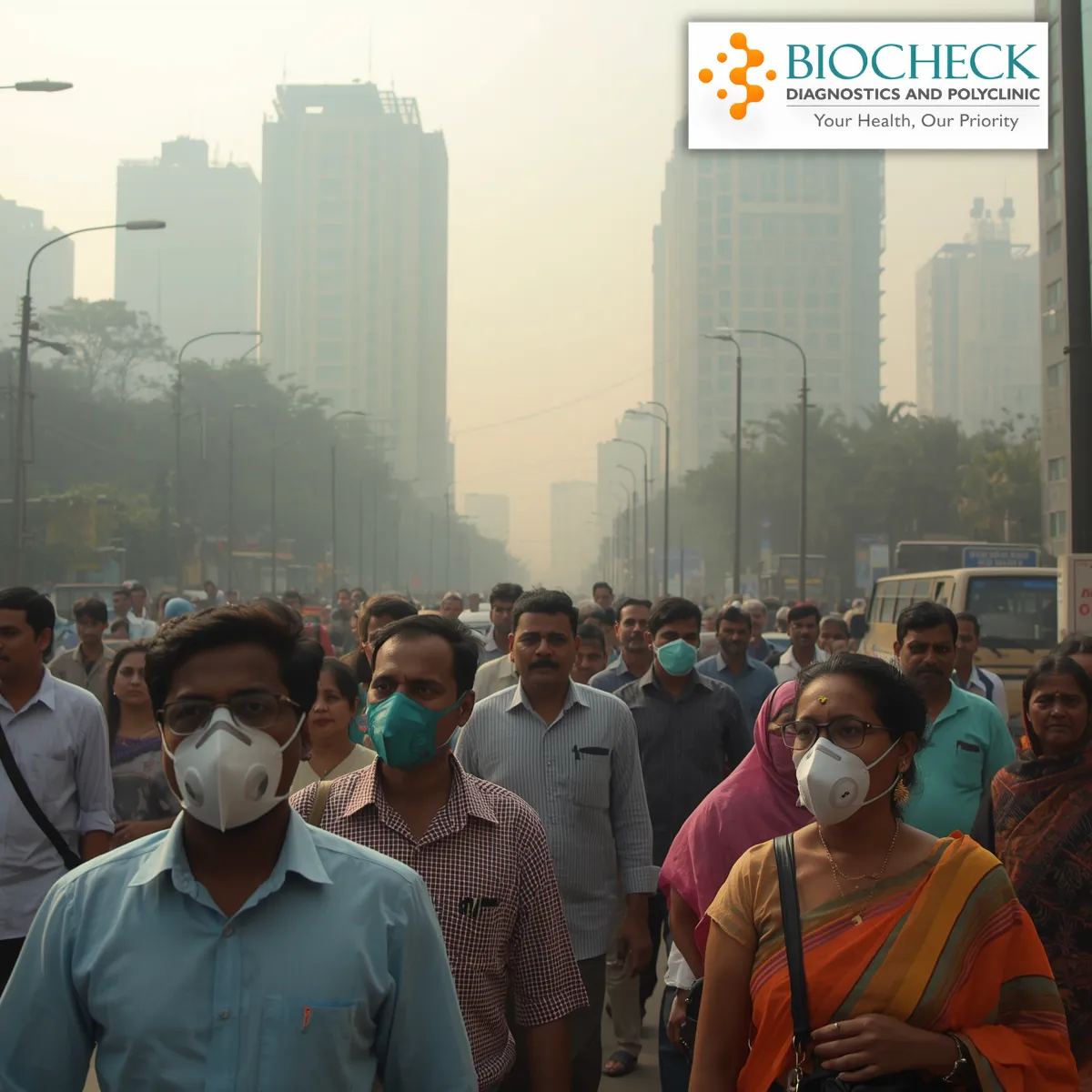
As you navigate the bustling streets of Goregaon West or commute via the Western Express Highway, the hazy horizon is often dismissed as mere "fog" or "humidity." However, for the millions living in Mumbai in 2026, the air we breathe has become a significant, albeit silent, contributor to cardiovascular disease.
While most people associate air pollution with respiratory issues like asthma or a persistent "Mumbai cough," modern clinical research has revealed a much more sinister connection: Urban air quality is a direct driver of heart attacks, strokes, and chronic hypertension. At Biocheck Diagnostics & Polyclinic, we are seeing an increasing number of patients who lead "healthy" lifestyles—non-smokers who exercise and eat well—yet show high markers of systemic inflammation. The culprit? The microscopic particulate matter (PM2.5) that bypasses the lungs and enters the bloodstream. This blog explores the science behind this link and how you can protect your heart through proactive diagnostics.
To understand the risk, we must understand the scale. Air pollution in Mumbai is largely comprised of Particulate Matter (PM). PM2.5 refers to particles that are less than 2.5 micrometers in diameter—about 30 times thinner than a human hair.
Because they are so small, these particles do not stop at your lungs. They travel deep into the alveolar sacs, cross the blood-air barrier, and enter your circulatory system. Once in the blood, these particles—composed of heavy metals, carbon, and toxic chemicals from vehicle exhausts and construction dust—trigger a cascade of biological damage.
Residents of Goregaon, Malad, and Andheri are currently at the epicenter of Mumbai’s redevelopment. Large-scale construction projects, while signaling progress, release massive amounts of silica dust and cement particles into the immediate atmosphere. For those living near S.V. Road or the Link Road, the daily exposure to these pollutants is equivalent to smoking several cigarettes a day.
The link between the air and your heart isn't just a theory; it is a measurable medical reality. There are three primary ways pollution damages your cardiovascular system:
When foreign particles enter the blood, the body’s immune system goes into overdrive. This creates a state of "chronic low-grade inflammation." Inflammation is the primary driver of Atherosclerosis—the hardening and narrowing of the arteries.
Pollutants generate "free radicals" in the body. These unstable molecules damage the endothelial lining (the inner "skin") of your blood vessels. When the lining is damaged, it becomes easier for cholesterol and fat to stick to the walls, forming dangerous plaques.
Breathing polluted air can trigger a "fight or flight" response in the nervous system. This can lead to sudden spikes in blood pressure and changes in heart rate variability (HRV), which can trigger arrhythmias or even sudden cardiac arrest in vulnerable individuals.
If you cannot change the air quality of Mumbai overnight, how do you protect yourself? The answer lies in Internal Monitoring. Most heart damage from pollution is "silent" until it is too late. At Biocheck Diagnostics, we recommend a specific panel of tests for residents in high-pollution zones.
The High-sensitivity C-reactive Protein (hs-CRP) test is perhaps the most important marker for pollution-related heart risk. Unlike a standard CRP test used for infections, the hs-CRP measures tiny amounts of inflammation in the blood vessels.
If you live in a high-traffic area like Goregaon West and your hs-CRP is high despite a good diet, air pollution is likely the cause.
Pollution can oxidize your LDL (bad cholesterol), making it more likely to clog your heart. A comprehensive Lipid Profile, coupled with a Lipoprotein (a) test, provides a clearer picture of your genetic and environmental risk.
Recent studies suggest that long-term exposure to PM2.5 can increase insulin resistance, making Mumbaikars more prone to Type 2 Diabetes, which in turn complicates heart health.
Many Mumbaikars ignore the early warning signs of pollution-related heart stress, attributing them to "work fatigue" or "humidity." Watch out for:
While we wait for better urban planning and more green cover in Mumbai, here are immediate steps you can take:
When dealing with environmental health risks, you need more than just a data printout. You need Clinical Correlation. At Biocheck Diagnostics, our reports are verified by an MD Pathologist. We don’t just tell you your hs-CRP is high; we help correlate that data with your lifestyle and local environmental factors. For residents of Goregaon, Jogeshwari, and Malad, having an expert medical team that understands the local "Mumbai context" is invaluable.
We offer Home Sample Collection across the western suburbs, ensuring you don't have to brave the traffic and pollution just to get your health checked. Your blood is drawn by professional phlebotomists and transported in temperature-controlled kits to our state-of-the-art lab on S.V. Road.
The hazy skyline of Mumbai shouldn't be a death sentence for your heart. While the "silent link" between air quality and cardiovascular health is a serious threat, it is one that can be managed through awareness and regular diagnostic testing.
Don't wait for a cardiac event to realize the impact of the environment on your body. Take the first step toward a "Pollution-Proof" heart today.
Don't let mobility or a busy schedule stand in the way of your heart health. Trust the experts who are "Your Health, Our Priority."
📍 Visit us today: 2-minute walk from Ram Mandir Station (West), Goregaon, Mumbai.
📞 Book Your Test: +91 93264 79274
Book Online: Book Your Test Appointment
| Test Name | Purpose | Frequency (for Mumbai Residents) |
|---|---|---|
| hs-CRP | Measures vascular inflammation | Every 6 months |
| Lipid Profile | Monitors cholesterol health | Every 6–12 months |
| Chest X-Ray | Checks for lung/heart congestion | Once a year |
| ECG | Detects heart rhythm issues | During annual checkup |
| HbA1c | Monitors long-term blood sugar | Every 6 months |
Available Near You
Whether you’re in Malad, Goregaon, Jogeshwari, Andheri or any part of Mumbai, BIOCHECK Diagnostics & Polyclinic is your trusted local centre for Health Packages and comprehensive Health Packages services.