
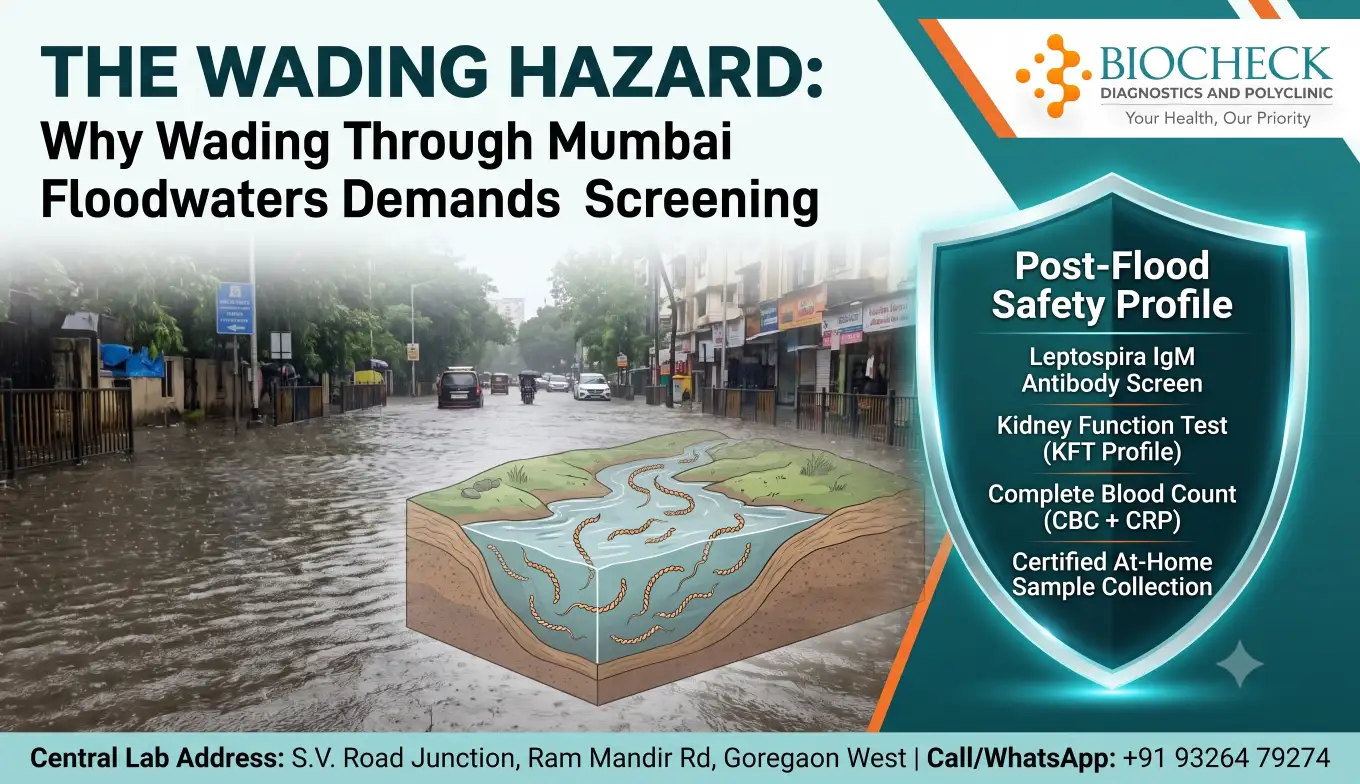
As of July 5, 2026, Mumbai is not just wet; it is witnessing a historic, extreme meteorological event. The India Meteorological Department (IMD) has placed the entire Mumbai Metropolitan Region (MMR) under a severe Red Alert.
The statistics from this first week of July are historic. Mumbai recorded nearly 94% of the entire month's average rainfall in just five days. This relentless deluge has completely overwhelmed the city’s drainage capacity, leading to widespread structural waterlogging and severe flooding across the western suburbs—with Goregaon West, Malad, Oshiwara, and low-lying clusters in Andheri bearing the brunt of the submerged reality.
For Mumbaikars navigating this record deluge, the chaos is visible: stalled vehicles, flooded subways, and waist-deep water on arterial roads like S.V. Road. But beyond the immediate disruption, there is a serious, microscopic public health emergency unfolding in the floodwaters.
Thousands of commuters and residents have been forced to wade through stagnant rainwater to reach safety or simply navigate their submerged neighborhoods. Wading through this dirty, mixed urban runoff creates a direct exposure risk for Leptospirosis—a potentially life-threatening bacterial infection that historically spikes sharply in Mumbai within 1–2 weeks of significant urban flooding.
At Biocheck Diagnostics & Polyclinic, located in the heart of the Goregaon-Malad medical hub at the S.V. Road Junction, we believe that education is the first step in preventive wellness. Wading through floodwaters was not just an inconvenience; it was a significant medical exposure event. Here is why you must not ignore that wading history, and why proactive screening is urgent this week.
Leptospirosis is a zootonic bacterial disease caused by the spirochete Leptospira. It is not spread directly from person to person (like COVID-19) or by mosquitoes (like Dengue/Malaria). Instead, it thrives in the unique, contaminated matrix of urban floods.
The primary vectors for Leptospirosis in Mumbai are rodents (rats), stray dogs, and sometimes livestock. These animals carry the Leptospira bacteria in their kidneys and excrete massive amounts of it through their urine into the environment.
When historic rainfall, such as the 300mm Mumbai deluges, lashes the city, it mixes with animal waste and flushes this concentrated bacterial load out of sewers, garbage dumps, and narrow alleyways directly into the stagnant floodwaters on main roads.
The Leptospira bacteria have unique motility; they swim aggressively in water. They do not require a deep puncture wound to enter your bloodstream. They can easily infiltrate the body through:
If you waded through water in Goregaon, Malad, or Andheri this week, you must assume your legs were exposed to Leptospira bacteria.
The biggest challenge in managing Leptospirosis in Mumbai is the incubation period. The bacteria do not cause symptoms instantly upon exposure. Following wading, the infection undergoes a "silent progression" phase that typically lasts 5 to 14 days (though it can range from 2 to 30 days).
While you may feel fine today, 10 days from now you could face an abrupt, severe medical crisis. This lag time is the primary reason why citizens delay diagnosis and medical consultation. By the time symptoms appear, the bacteria may have already begun invading your vital organs. Proactive screening during this window—before the full-blown fever strikes—is the most effective way to intercept the disease and prevent it from advancing.
When Leptospirosis transitions into its symptomatic phase, it often strikes with sudden, extreme intensity. It is frequently misdiagnosed initially, as the early symptoms mirror a severe viral flu.
However, if you have a recent history of wading through Mumbai floodwater, you must look for specific differentiating signposts that demand immediate pathology:
Mumbai's monsoon season is complicated by "The Co-Circulating Fever Wave." Dengue, Malaria, and Leptospirosis often flare up simultaneously because they all thrive in the stagnant, waterlogged environment left by a Red Alert.
Because the early symptoms (high fever, headache, body aches) are so similar, you cannot diagnose based on symptoms alone. In Goregaon, where standard pathology labs may offer generic testing, you need the authoritative expertise of a specialized diagnostic center.
Dengue causes a severe drop in platelet counts; Malaria presents with classic cold-hot-sweat cyclical chills. Leptospirosis, however, leaves subtle clues in your blood work and kidney function data that require meticulous review.
At Biocheck Diagnostics, every monsoon acute fever panel, morphology smear, and antibody screen is verified by qualified MD Pathologists. Automation can flag parameters, but only a skilled pathologist can differentiate subtle cellular shifts, identify bacterial impacts on kidney filtration, and contextually evaluate your wading history against co-circulating viral markers to avoid dangerous diagnostic overlap errors.
This human oversight ensures that subtle indicators—such as early toxic granulations in white cells, changes in the urea-to-creatinine ratio, or specific antibody patterns—are accurately identified before your report is delivered.
This dedication to clinical accuracy ensures your family physician receives a dependable foundation for your treatment plan. To learn more about our laboratory protocols, read our article on why MD Pathologist-led laboratory reports are vital in Mumbai.
Leptospirosis typically occurs in two phases.
The initial sudden high fever, headache, and body aches described above. This phase usually lasts 3 to 7 days.
If the initial phase is self-treated or mismanaged, a significant percentage of patients enter a severe second phase. The fever may decrease briefly, leading to a false sense of recovery, only to return with systemic complications, known as Weil’s Disease. This stage can involve:
Accurate pathology during the first 1 to 3 days of symptoms (the first phase) allows for targeted antibiotic intervention that halts bacterial replication, intercepting the immune phase and ensuring full recovery.
The Red Alert deluges create a localized diagnostic emergency. If you have waded through floodwaters, you must act proactively. Don't wait for symptoms to force you into an emergency room.
At Biocheck Diagnostics, we have streamlined our protocols to support high-risk individuals in the Goregaon-Malad-Andheri belt:
The biggest barrier to proactive healthcare after a Red Alert deluge is the very environment that caused the risk: Continued Waterlogging and Disrupted Transit.
With the BMC actively advising Mumbaikars to avoid wading and unnecessary travel due to blocked subways and submerged streets, commuting to a laboratory while feeling unwell or anxious is dangerous. We remove this friction.
Located strategically on S.V. Road Junction, Ram Mandir Rd (Goregaon West), Biocheck Diagnostics & Polyclinic operates a professional, rapid Home Sample Collection service.
We provide secure, hygienic phlebotomy across a seamless 5–7 km operational radius, covering:
Our certified phlebotomists follow rigorous sanitization protocols and use specialized, temperature-controlled transport bags. This crucial temperature management prevents delicate blood enzymes and antibody samples from degrading in the extreme humidity and heat following Mumbai deluges, preserving the absolute stability and precision of your diagnostic data from your doorstep to our advanced molecular analyzer.
You cannot change your history of wading through floodwaters, but you can change how you manage the diagnostic outcome. Waiting for a high fever to strike is "Sick Care." Screening early, intercepting silent bacterial progression, and preserving your renal/liver function is true "Well Care."
Invest in your health journey before symptoms force your hand. Use advanced diagnostics to optimize your health from the inside out.
Explore our comprehensive screening package by visiting our page on affordable pathology tests in Mumbai and Goregaon, or select tailored baseline parameters from our directory of pathology services.
📍 Address: Samadhan Asshna Developers, B Wing, 203/204 S.V.Road, Junction, Ram Mandir Rd, Goregaon West, Mumbai, Maharashtra 400104, India
📞 Call / WhatsApp: +91 93264 79274
🌐 Official Portal: https://biocheckdiagnostics.com
Available Near You
Whether you’re in Malad, Goregaon, Jogeshwari, Andheri or any part of Mumbai, BIOCHECK Diagnostics & Polyclinic is your trusted local centre for Health Packages and comprehensive Health Packages services.