
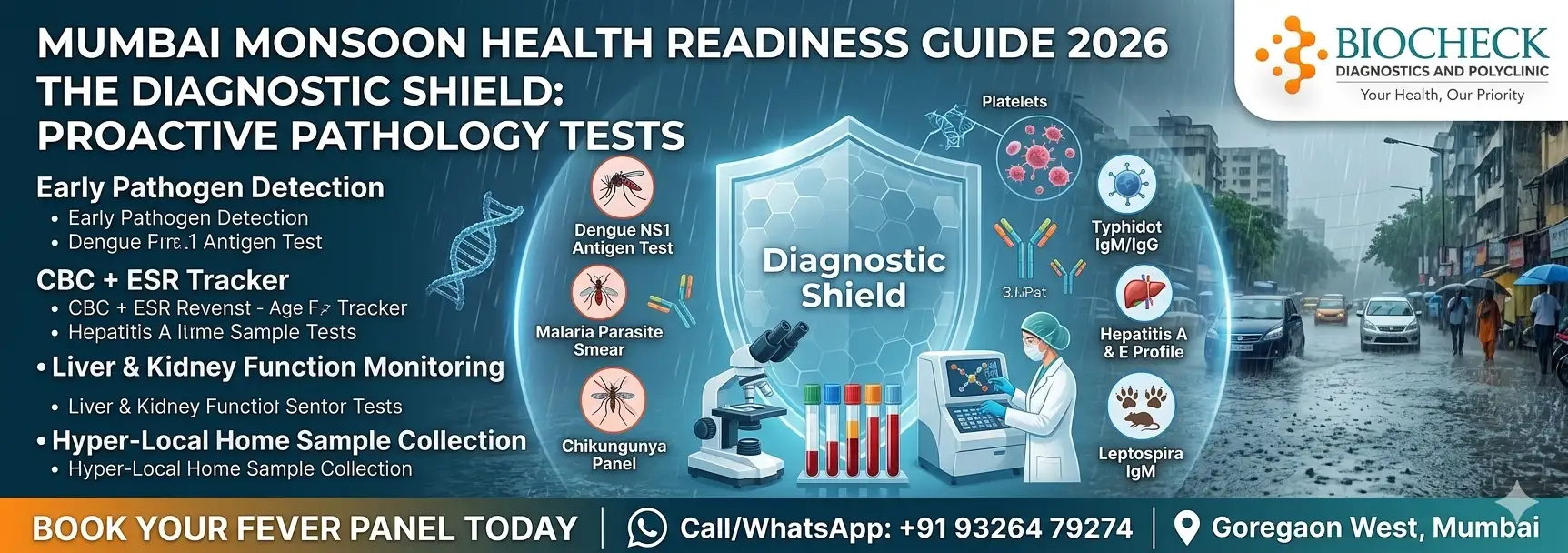
As the southwest monsoon approaches the Mumbai Metropolitan Area, the convergence of urban waterlogging, high humidity, and vector propagation creates significant public health challenges. This comprehensive clinical guide outlines the pathophysiology of local monsoon diseases, delineates early differential symptoms, and presents the definitive laboratory diagnostics necessary to safeguard individuals and corporate teams across Mumbai's Western Suburbs.
The arrival of the southwest monsoon in the Mumbai Metropolitan Area is historically accompanied by an exponential surge in acute febrile illnesses, gastrointestinal disorders, and systemic infections. In high-density geographical belts within Mumbai’s Western Suburbs—stretching across Goregaon West, Malad, Kandivali, and Jogeshwari—the specific ecological conditions of waterlogging, high ambient humidity (frequently exceeding 85%), and localized stagnation provide prime breeding vectors for pathogens.
For clinical professionals, enterprise heads, and proactive residents, waiting for the manifestation of explosive clinical symptoms during peak downpours constitutes an operational and medical vulnerability. True epidemiological resilience requires a paradigm shift from reactive treatment to high-precision, preventative laboratory diagnostics.
Early diagnostics do not merely mitigate individual healthcare expenditures by cutting down prolonged tertiary hospitalization risks; they prevent widespread cross-infection vectors within local communities and corporate workplaces. At Biocheck Diagnostics & Polyclinic, our clinical laboratory tracks these micro-epidemiological shifts in real-time under MD Pathologist oversight to provide actionable data for early intervention.
The healthcare landscape during a Mumbai monsoon is dictated by three highly distinct yet clinically overlapping pathways of transmission. Understanding these vectors allows for strategic diagnostic deployment.
Early diagnostics do not merely mitigate individual healthcare expenditures by cutting down prolonged tertiary hospitalization risks; they prevent widespread cross-infection vectors within local communities and corporate workplaces. At Biocheck Diagnostics & Polyclinic, our clinical laboratory tracks these micro-epidemiological shifts in real-time under MD Pathologist oversight to provide actionable data for early intervention.
Intermittent heavy downpours coupled with urban construction sites and poorly draining housing societies along S.V. Road create localized freshwater pockets. These micro-environments accelerate the breeding cycles of Aedes aegypti (the vector for Dengue and Chikungunya) and Anopheles mosquitoes (the vector for Malaria).
The overloading of municipal drainage infrastructures during flash floods often results in cross-contamination of drinking water pipelines and shallow aquifers. This structural challenge exposes populations to high titers of bacterial and viral agents through raw ingestion or compromised food handling.
Perhaps the most specific and lethal threat during the Mumbai rains is Leptospirosis. Triggered by the pathogenic spirochete bacterium Leptospira interrogans, this disease is shed through the urine of infected rodents, which proliferates through waterlogged streets, urban slush, and contaminated puddles near transit stations like Goregaon and Ram Mandir.
Humans walking through flooded streets with minor skin abrasions or micro-cuts absorb the spirochetes directly into their bloodstream, setting off a systemic vasculitis that can rapidly advance to Weil’s Disease (characterized by concurrent multi-organ liver and kidney failure).
During the early acute phase (Days 1 to 3 of fever), almost all monsoon pathogens present with a remarkably uniform symptom matrix: high-grade pyrexia, generalized myalgia, cephalalgia (headaches), and severe physical exhaustion. Relying purely on a physical examination can lead to a dangerous clinical misdiagnosis.
| Clinical Condition | Primary Diagnostic Target | Early Sentinel Symptoms | Critical Lab Markers |
|---|---|---|---|
| Dengue Fever | Vascular & Platelet Systems | Retro-orbital pain, severe bone arthralgia, petechiae | Leukopenia, Rapid Thrombocytopenia, Hct Spike |
| Malaria | Intra-erythrocytic Parasites | Cyclical cold chills followed by drenching diaphoresis | Hemolytic Anemia, Hyperbilirubinemia |
| Leptospirosis | Systemic Endothelium & Capillaries | Intense calf-muscle tenderness, conjunctival suffusion | Elevated Creatinine/BUN, Mild Prolonged PT |
| Typhoid Fever | Gastrointestinal / Peyer’s Patches | Step-ladder fever escalation, bradycardia, coated tongue | Relative Lymphocytosis, Neutropenia |
As indicated by the clinical data table, attempting to distinguish between early-stage Dengue and early-stage Leptospirosis without laboratory testing presents an unacceptable medical risk. For instance, giving a patient an initial dose of certain NSAIDs for severe body aches—assuming it is a standard flu—can cause catastrophic internal hemorrhaging if the patient actually has underlying Dengue with a crashing platelet count.
To combat this seasonal diagnostic challenge, Biocheck Diagnostics & Polyclinic has formulated an array of specialized pathology profiles. These tests replace empirical guesswork with definitive, molecular, and serological evidence.
The absolute foundation of monsoon triage is a high-resolution CBC. It provides immediate, indirect evidence of the body's physiological response to infection:
Waiting for antibodies to form means delaying critical treatment. We utilize advanced early-detection protocols:
For water-contact illnesses and enteric spikes:
Infections do not exist in a vacuum; they strain vital organs.
True readiness involves setting up multi-layered defenses long before the first heavy downpour hits the coastline.
Residential housing societies across areas like Jawahar Nagar and Siddharth Nagar must initiate comprehensive vector eradication protocols. Ensure overhead and underground tanks are securely sealed. Inspect common stagnant areas, flowerpot bases, and elevator shafts weekly. Mosquitoes carrying Dengue are day-biters; utilizing barrier protections and routine residential space-spraying dramatically alters infection curves.
High water tables during flooding can compromise domestic storage units. Society committees should schedule thorough tank cleaning and professional water-purity evaluations in May. On an individual level, shifting to mechanical water purification combined with thermal boiling remains the most effective protection against water-borne Hepatitis and Typhoid strains.
Individuals living with pre-existing metabolic vulnerabilities—such as chronic kidney disease, advanced diabetes (tracked via HbA1c), or structural cardiac disorders—possess minimal physiological reserves. For these groups, an undetected infection can quickly escalate into a medical crisis. Establishing a baseline KFT, LFT, and metabolic status in May allows physicians to interpret subsequent diagnostic shifts accurately if a monsoon infection occurs.
For modern corporations, IT hubs, and financial enterprises situated throughout Mumbai's commercial corridors, the monsoon season presents a distinct operational challenge. Mass employee absenteeism driven by seasonal outbreaks can severely disrupt project timelines and compromise corporate output.
For forward-thinking organizations, managing healthcare reactively through sick-leave policies is insufficient. Implementing a structured corporate screening blueprint before seasonal spikes occur provides essential protection.
Organizing on-site diagnostic camps or securing health voucher checkups for employees provides an empirical map of organizational vulnerability. Identifying personnel with compromised immune statuses or sub-clinical chronic issues allows companies to allocate remote work assignments logically before flood conditions exacerbate infection vectors.
Furthermore, equipping employees with direct access to reliable home sample collection services ensures that if an employee manifests a sudden fever, they can be tested immediately from home. This limits extended secondary infections within open-plan offices and minimizes baseline operational downtime.
Biocheck Diagnostics & Polyclinic operates as a critical healthcare anchor across the Western Suburbs, deliberately structured to handle the intensive diagnostic demands of the Mumbai monsoon.
High ambient humidity and heavy rainwater exposure can easily degrade blood samples during transit if they are not handled with strict protocols. Our phlebotomists utilize specialized, temperature-insulated transit kits to guarantee that all samples remain structurally stabilized from the precise moment of collection until they reach our analyzer matrices.
We reject fully automated, unverified report distribution models. Every single abnormal value—whether a critical drop in platelets or a sudden spike in serum creatinine—is subjected to direct verification by an expert MD Pathologist, ensuring high clinical correlation before delivery.
Wading through monsoon traffic or flooded roads while suffering from a high fever is exhausting and medically counterproductive. Our phlebotomy network delivers seamless home sample collection within a 5–7 km radius of our central lab, covering Goregaon East and West, Malad East and West, Oshiwara, Jogeshwari, and Upper Andheri.
The Mumbai monsoon of 2026 does not have to be characterized by predictable health crises and reactive medical interventions. By recognizing the clinical overlap of seasonal pathogens and deploying targeted laboratory diagnostics early, individuals, families, and corporate organizations can successfully navigate the upcoming season.
Do not let a minor fever escalate into a major medical emergency. Stay ahead of the seasonal transition by securing precise, timely diagnostic data.
Connect directly with our laboratory scheduling desk to book individual screenings, family wellness profiles, or corporate camp deployments.
📍 Visit us today: 2-minute walk from Ram Mandir Station (West), Goregaon, Mumbai.
📞 Book Your Test: +91 93264 79274
Book Online: Book Your Test Appointment
Available Near You
Whether you’re in Malad, Goregaon, Jogeshwari, Andheri or any part of Mumbai, BIOCHECK Diagnostics & Polyclinic is your trusted local centre for Health Packages and comprehensive Health Packages services.