
Late July in Mumbai brings a distinct shift in the atmosphere. As the relentless, heavy downpours begin to leave behind massive pools of stagnant water across the western suburbs, the city transitions into a high-risk zone for seasonal health crises. For many Mumbaikars, the most debilitating of these issues is not just a standard fever, but sudden, crippling joint pain.
Navigating the flooded streets of Goregaon, climbing the stairs at Malad station, or simply trying to type at a desk can suddenly become agonizing tasks. But what exactly is causing this severe musculoskeletal distress?
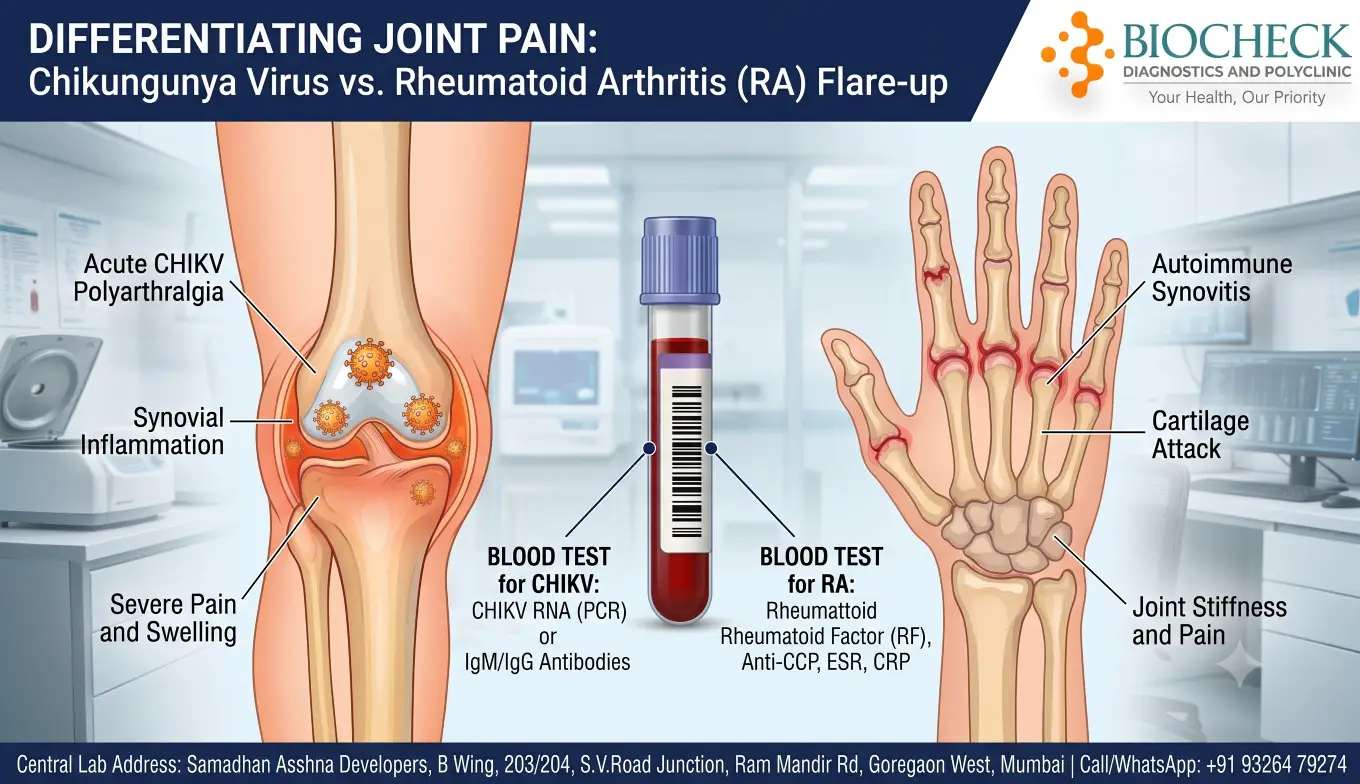
During the peak of the monsoon, acute joint pain typically stems from one of two entirely different biological sources: an environmental trigger causing a Rheumatoid Arthritis (RA) flare-up, or a mosquito-borne viral infection known as Chikungunya.
Because the end result—intense, restrictive pain—feels similar, patients often misdiagnose themselves. Applying pain-relief balms or popping over-the-counter painkillers without knowing the root cause can allow the underlying condition to severely damage your joint cartilage. To stop the pain, you must identify the exact biological culprit.
Before diving into infectious diseases, it is vital to understand why the Mumbai monsoon inherently physically hurts. Even individuals without chronic conditions often complain of "creaky" or stiff knees during the rainy season. This is entirely driven by meteorology.
When a heavy monsoon storm system rolls in over the Arabian Sea, the barometric (atmospheric) pressure drops significantly. Under normal, sunny conditions, atmospheric pressure pushes against the human body, helping to keep tissues contained. When that pressure drops, the tissues, tendons, and muscles inside your body subtly expand.
Because the human joint capsule offers limited space, this sudden tissue expansion places immense mechanical pressure on the nerves surrounding the joint. When combined with Mumbai's extreme 90%+ humidity—which can thicken the synovial fluid that lubricates your joints—your mobility becomes stiff, restrictive, and painful.
While this environmental shift causes discomfort for the average person, it acts as a catastrophic trigger for individuals with underlying autoimmune conditions.
Rheumatoid Arthritis (RA) is a chronic inflammatory disorder. Unlike osteoarthritis, which is caused by the natural wear-and-tear of aging, RA is an autoimmune condition. This means your body’s immune system mistakenly attacks the synovium—the lining of the membranes that surround your joints.
For a patient living with RA, the immune system is already on edge. When the barometric pressure drops and tissues expand during the July rains, the already-inflamed synovium is placed under extreme stress. This triggers a massive "flare-up," characterized by a sudden, intense spike in disease activity.
If you do not have a history of autoimmune disease and your joint pain strikes out of nowhere alongside a fever, the culprit is likely lurking in the stagnant water outside your window.
Chikungunya is a viral disease transmitted to humans by infected Aedes aegypti and Aedes albopictus mosquitoes. These are the same daytime-biting mosquitoes responsible for spreading Dengue. Following the massive waterlogging of the early July deluge, the breeding cycle of the Aedes mosquito is currently at its absolute peak in areas like Jogeshwari, Goregaon, and Malad.
The word "Chikungunya" translates to "that which bends up" in the Kimakonde language, perfectly describing the contorted, stooped posture of patients suffering from the disease's severe joint pain.
Once the virus enters the bloodstream, it specifically targets the musculoskeletal system. It induces a massive, systemic inflammatory response (polyarthralgia) that attacks the joint capsules.
When you are in pain, self-diagnosing can be dangerous. Use this clinical matrix as a baseline to understand your symptoms before consulting a physician.
| Clinical Feature | Chikungunya Infection | Rheumatoid Arthritis Flare-Up |
|---|---|---|
| Onset Timeline | Abrupt and sudden, usually 3–7 days after a mosquito bite. | Gradual worsening over days, specifically triggered by weather shifts. |
| Fever Presentation | Sudden, high-grade fever (often above 102°F). | Rare. May have a low-grade temperature or general malaise. |
| Joint Symmetry | Often asymmetrical, though multiple joints are involved. | Highly symmetrical (e.g., both wrists, both knees). |
| Morning Stiffness | Pain is constant throughout the day and with movement. | Severe stiffness upon waking, lasting for more than 60 minutes. |
| Skin Manifestations | Often accompanied by a red, measles-like rash. | Rheumatoid nodules (lumps under the skin) may be present. |
You cannot treat Chikungunya with autoimmune immunosuppressants, and you cannot treat a severe RA flare-up with standard antiviral rest protocols. Securing absolute diagnostic clarity through targeted blood tests is the only way to protect your joint cartilage from irreversible damage.
At Biocheck Diagnostics & Polyclinic, our Directory of Services offers the exact, high-precision pathology required to differentiate these conditions instantly.
Standard clinical laboratories often use a basic Latex Agglutination test for RA, which is prone to false positives and lacks sensitivity. At Biocheck Diagnostics, we utilize the advanced Rheumatoid Arthritis (RA) - Turbidimetric Method (Serology).
This automated, highly sensitive method measures the exact concentration of Rheumatoid Factors (autoantibodies) in your blood by analyzing how light passes through the sample. It provides a precise quantitative value rather than a simple "positive or negative" result. This allows your rheumatologist to gauge the exact severity of the flare-up and adjust your medication dosage accordingly.
When you are suffering from severe joint pain, navigating Mumbai's waterlogged roads, heavy traffic, and crowded clinic waiting rooms is a logistical nightmare.
You do not need to subject your inflamed joints to a stressful commute. Biocheck Diagnostics brings state-of-the-art clinical pathology directly to your doorstep. Our certified phlebotomists are equipped to perform safe, hygienic, and temperature-controlled home sample collections within a 5-7 km radius of our Goregaon West laboratory.
Every single serology and hematology report generated by our facility is meticulously reviewed and verified by an MD Pathologist. This human oversight ensures that complex inflammatory markers and subtle cellular shifts are accurately interpreted, giving your physician the exact data they need to stop your joint pain at its source.
Do not let the monsoon dictate your mobility. Whether you are battling the aftermath of a mosquito bite or an environmental autoimmune trigger, accurate diagnostics are your first line of defense.
📍 Central Laboratory: Samadhan Asshna Developers, B Wing, 203/204 S.V.Road, Junction, Ram Mandir Rd, Goregaon West, Mumbai, Maharashtra 400104
📞 Direct Hotline / WhatsApp Booking:
+91 93264 79274
🌐 View Our Full Test Directory:
https://biocheckdiagnostics.com/directory-of-services-pathology-laboratory
Available Near You
Whether you’re in Malad, Goregaon, Jogeshwari, Andheri or any part of Mumbai, BIOCHECK Diagnostics & Polyclinic is your trusted local centre for Serology and comprehensive Serology services.