
As the monsoon clouds finally clear over the Mumbai skyline, residents are greeted not by pleasant autumn breezes, but by the relentless, stifling phenomenon known as the "October Heat." This secondary summer brings a sharp, aggressive spike in temperatures, often pushing past 35°C, combined with the lingering, suffocating humidity left behind by the rainy season.
For the millions of commuters navigating the bustling western suburbs—traveling from Kandivali, Borivali, and Malad down to the commercial nerve centers of Goregaon and Andheri—this weather is more than just uncomfortable. It is a severe biological stressor. While most people associate extreme heat solely with sunburns or basic dehydration, clinical specialists—particularly nephrologists and urologists—view October through a very different lens.
In the medical community, October in Mumbai is synonymous with a massive, predictable surge in acute urological emergencies. The waiting rooms of clinics across the western suburbs fill with patients experiencing the agonizing, crippling pain of kidney stones (renal calculi) and the relentless, burning discomfort of Urinary Tract Infections (UTIs). Understanding the direct, physiological link between the October Heat and your renal system is the first step in protecting your kidneys and bladder from severe, painful complications.
To comprehend why kidney stones and UTIs skyrocket during this season, it is essential to understand the basic mechanics of your renal system. Your kidneys are the master filtration plants of your body. Every single day, they filter approximately 150 to 180 liters of blood, extracting metabolic waste, excess minerals, and toxins, and flushing them out of your system through urine.
This highly efficient filtration process relies entirely on an adequate supply of water. Water acts as the essential solvent that keeps these waste products diluted and moving smoothly through your delicate microscopic kidney tubules, down your ureters, into your bladder, and safely out of your body.
During the October Heat, this delicate balance is violently disrupted. When you wait for a train at the Borivali station or walk through the sun-baked streets of Mahavir Nagar, your body attempts to cool its core temperature through profuse sweating. You lose massive amounts of water through your skin.
If you do not replace this lost water rapidly and consistently, your brain sends a panic signal to your kidneys via an anti-diuretic hormone (ADH). The message is clear: Stop producing urine; we need to conserve every drop of water for the brain and heart.
As a direct result, your urine volume drops drastically. The kidneys are forced to cram the exact same amount of metabolic waste into a significantly smaller volume of water. Your urine becomes highly concentrated, turning from a healthy, pale straw color to a dark, alarming shade of amber or brown. This state of super-concentration is the exact physiological trigger that leads directly to the formation of kidney stones and the proliferation of bacterial infections.
Kidney stones are hard, solid masses composed of crystallized minerals and salts that form inside your kidneys. When your urine is adequately diluted, these minerals—most commonly calcium, oxalate, and uric acid—remain dissolved in liquid form. However, when your urine becomes super-concentrated due to October heat dehydration, the liquid can no longer hold the minerals in a dissolved state.
The minerals begin to precipitate out of the liquid, binding together to form microscopic crystals. In a state of chronic dehydration, these tiny crystals act as a foundation, accumulating more and more minerals over days and weeks until they grow into solid, jagged stones.
A kidney stone resting quietly inside the kidney often produces no symptoms at all. The crisis occurs when the stone decides to move. As it exits the kidney and attempts to travel down the ureter—the tiny, narrow tube connecting the kidney to the bladder—it frequently gets stuck.
This blockage prevents urine from draining. The urine backs up, causing the kidney to swell (a condition called hydronephrosis). The ureter, attempting to push the stone out, goes into violent, relentless spasms. This results in what doctors call "renal colic"—a sudden, excruciating, stabbing pain in the flank (the side of the back, just below the ribs) that often radiates down into the lower abdomen and the groin.
The pain of a kidney stone is frequently described by patients as being worse than childbirth. It comes in intense waves, completely incapacitating the patient, and is often accompanied by profound nausea, vomiting, and visible blood in the urine (hematuria) as the jagged edges of the stone scrape the delicate lining of the urinary tract.
While kidney stones are a mechanical problem caused by concentrated minerals, Urinary Tract Infections (UTIs) are a biological hazard exacerbated by the exact same dehydration.
Your urinary tract is lined with a delicate mucous membrane designed to protect against bacterial invasion. Normally, the frequent, high-volume flow of dilute urine acts as a powerful, mechanical flushing mechanism. It aggressively washes away any harmful bacteria (such as E. coli) that may have entered the urethra before they have a chance to attach to the bladder walls and multiply.
During the October Heat, this natural defense mechanism fails. When you are dehydrated, you urinate far less frequently. The urine that sits in your bladder is highly concentrated, highly acidic, and deeply irritating to the bladder lining, causing microscopic inflammation.
Furthermore, because the urine is stagnant in the bladder for long periods, it creates a warm, nutrient-rich incubator for bacteria. Without the regular mechanical flushing of frequent urination, bacteria rapidly adhere to the inflamed bladder walls and multiply exponentially.
Women are anatomically much more susceptible to UTIs than men, and the October Heat significantly multiplies this risk. Ignoring the early signs of a UTI is dangerous, as the infection can quickly travel up the ureters and infect the kidneys themselves—a severe condition known as pyelonephritis, which can lead to sepsis.
Do not ignore these critical warning signs:
Dysuria: A sharp, stinging, or intense burning sensation during urination.
Urgency and Frequency: Feeling a sudden, desperate, uncontrollable urge to urinate, only to pass a few painful drops.
Pelvic Pain: A dull, heavy, persistent ache in the center of the pelvis or lower abdomen.
Cloudy or Foul-Smelling Urine: Urine that appears thick, milky, or has an unusually strong, unpleasant odor due to the presence of pus cells (dead white blood cells and bacteria).
Low-Grade Fever: A sign that your immune system is actively fighting the bacterial overgrowth.
If you are experiencing unexplained lower back pain, changes in your urination patterns, or a burning sensation, drinking cranberry juice is not a medical strategy. You require immediate, objective clinical diagnostics to determine the exact cause and severity of your condition.
At Biocheck Diagnostics, our integrated pathology and radiology teams utilize a comprehensive diagnostic triad to definitively map your urological health.
This is the fundamental, non-negotiable frontline test for any urinary symptom. A standard Urine Routine goes far beyond simply looking at the color. It provides a massive amount of clinical data:
Chemical Analysis: We check the exact pH of your urine and look for the presence of nitrites and leukocyte esterase, which are rapid chemical indicators of a severe bacterial infection.
Microscopic Analysis: Our pathologists examine the urine sediment under a high-powered microscope. We look for Red Blood Cells (indicating a stone is scraping the tract), Pus Cells (confirming a UTI), and the specific shapes of microscopic crystals (identifying exactly what type of stone your body is forming, be it calcium oxalate or uric acid).
Urine Culture: If an infection is detected, a culture test identifies the exact strain of bacteria causing the UTI and determines precisely which antibiotic will effectively kill it, preventing antibiotic resistance.
A simple blood draw is required to ensure that severe dehydration, an obstructing stone, or a severe infection has not caused acute damage to your kidneys. We measure Serum Creatinine and Blood Urea Nitrogen (BUN). If these metabolic waste products are accumulating in your blood, it indicates that your kidneys' filtration capacity is compromised and requires immediate medical intervention.
Blood and urine tests tell us that a problem exists, but an ultrasound shows us exactly where it is.
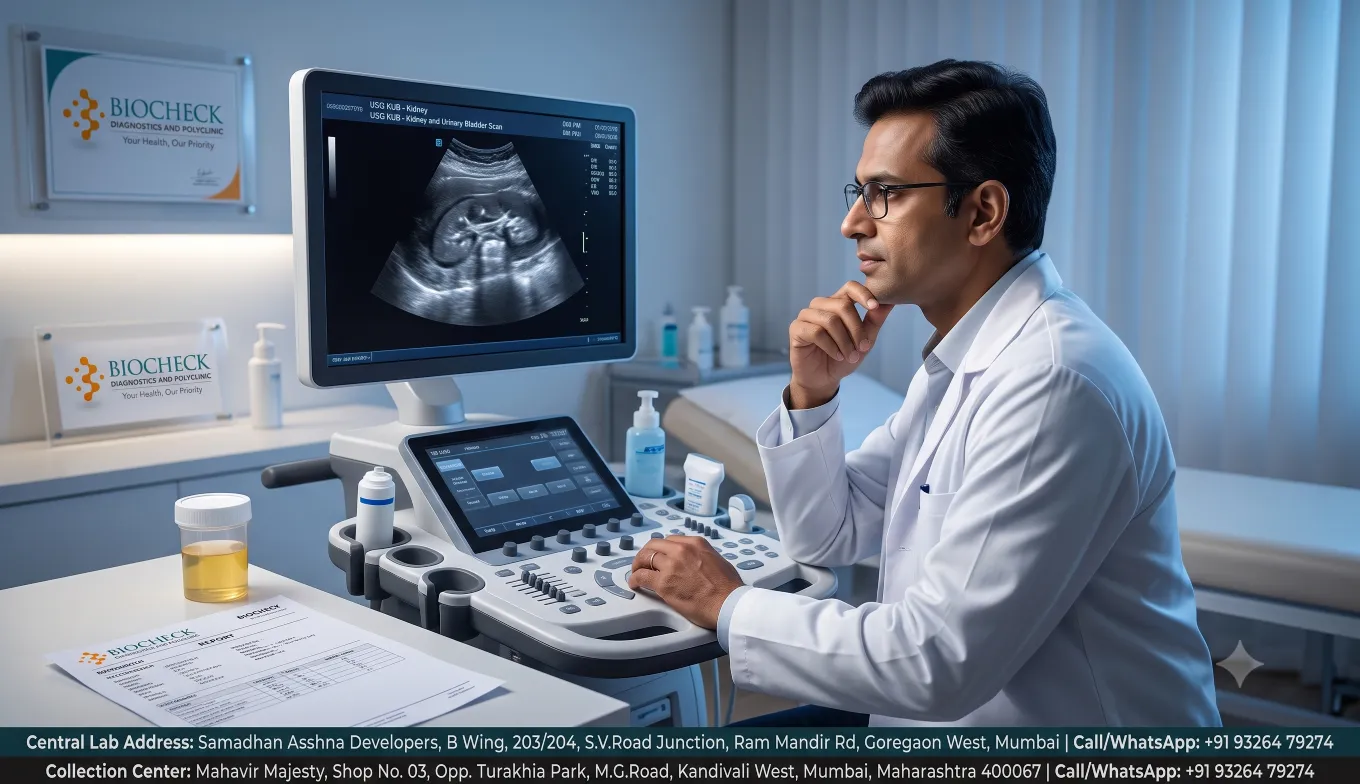
If a kidney stone is suspected, an ultrasound is the safest, fastest, and most effective imaging modality. Unlike CT scans, an ultrasound uses zero harmful radiation. It utilizes high-frequency sound waves to create real-time, high-definition images of your entire renal system.
Our expert M.D. Radiologists use the USG KUB to:
Detect the exact location and millimeter size of a kidney stone.
Identify "acoustic shadowing," a distinct visual marker that confirms the presence of a hard, calcified mass.
Measure the thickness of the bladder wall to assess chronic inflammation from severe UTIs.
Check for Hydronephrosis, measuring the exact degree of kidney swelling caused by a blocked ureter to determine if surgical intervention is necessary.
Protecting your kidneys during Mumbai's second summer requires conscious, daily effort. You must adapt your lifestyle to outsmart the environment.
The "Clear Urine" Benchmark: Do not measure your hydration by how many glasses of water you drink; measure it by the color of your urine. Your absolute goal is to maintain pale, almost clear urine throughout the entire day. If your urine is dark yellow, you are actively increasing your risk of stones and infections.
Strategic Hydration: If you are sweating heavily during your commute, plain water is not enough. You must replenish electrolytes to help your cells absorb the water. Incorporate fresh lemon water, coconut water, and watery fruits like cucumber and watermelon into your daily routine.
Reduce Stone-Forming Dietary Triggers: If you have a history of kidney stones, the October heat is the time to be incredibly strict with your diet. Dramatically reduce your intake of excess sodium (which forces your kidneys to excrete more calcium into your urine). Limit dark colas and excess animal proteins, which increase the uric acid load on your renal system.
Navigating a painful urological issue is stressful enough without having to commute across the city for separate blood tests and ultrasound scans. Biocheck Diagnostics has strategically positioned our facilities to provide seamless, integrated care across the western suburbs.
For rapid, hygienic laboratory testing, you can walk directly into our newly launched Pathology Collection Center at Shop No. 3, Mahavir Majesty (opposite Turakhia Park in Dahanukar Wadi, Kandivali West). You can drop off your urine samples and get a fast blood draw for your Kidney Function Tests first thing in the morning.
If you are in severe pain and cannot travel, take advantage of our Home Sample Collection service. Our expert technicians will arrive at your doorstep anywhere in Malad, Borivali, or Kandivali, ensuring your blood and urine samples are collected with complete privacy and comfort.
For diagnostic imaging and radiological analysis, our Central Laboratory and Polyclinic is conveniently located at the S.V. Road Junction in Goregaon West (near Ram Mandir Road). Equipped with state-of-the-art sonography machines and led by senior M.D. Radiologists, we guarantee precise, zero-wait-time USG KUB scans to locate stones and assess bladder health instantly.
Do not ignore a burning sensation or a persistent ache in your lower back this October. A minor infection can turn into a severe kidney issue in a matter of days under extreme heat stress. Contact Biocheck Diagnostics today to book your comprehensive Kidney Health Profile or schedule your KUB Ultrasound, and secure your peace of mind.
Available Near You
Whether you’re in Malad, Goregaon, Jogeshwari, Andheri or any part of Mumbai, BIOCHECK Diagnostics & Polyclinic is your trusted local centre for Health Packages and comprehensive Health Packages services.