
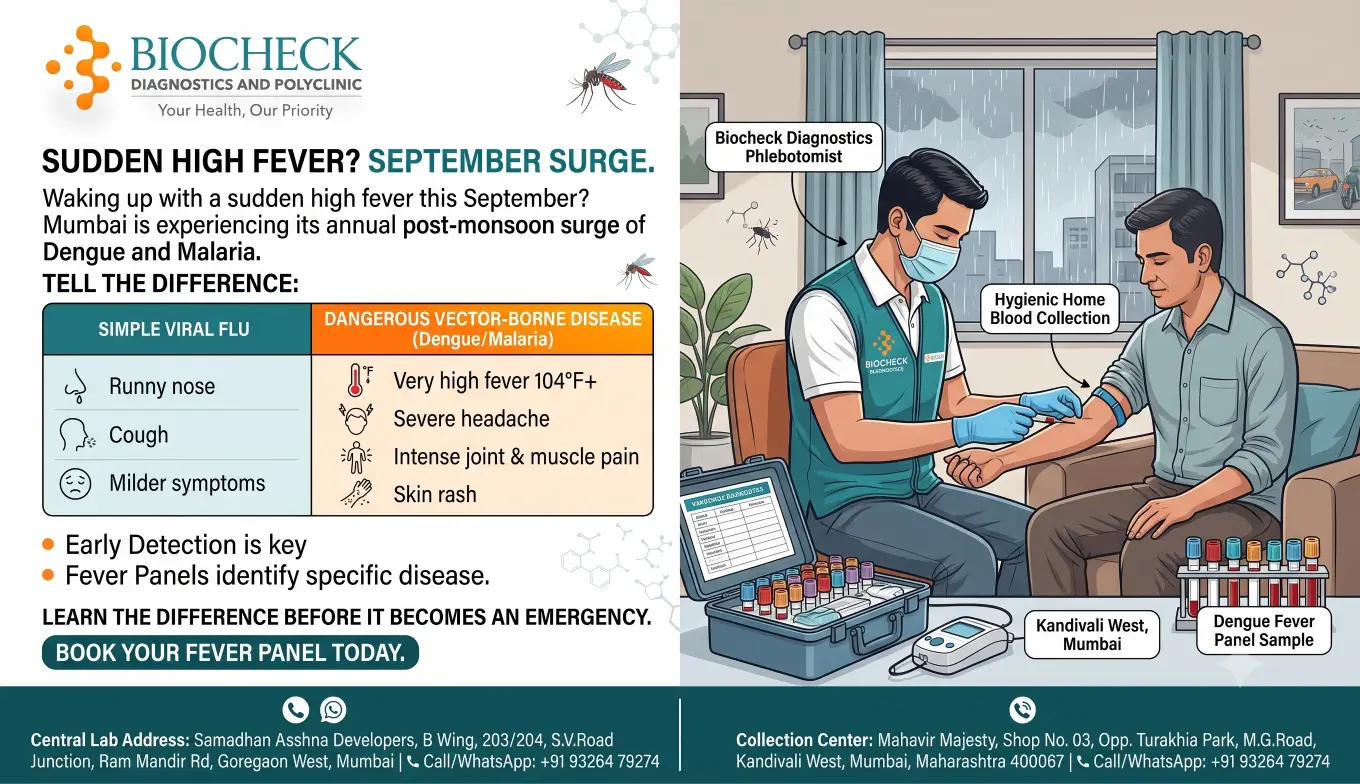
As the heavy, relentless monsoon rains of July and August finally begin to recede, September brings a different kind of storm to Mumbai. The scattered showers combined with high humidity and stagnant water puddles across the city create the absolute perfect breeding ground for the Aedes aegypti mosquito. Historically and clinically, September marks the absolute peak of vector-borne diseases in the Mumbai Metropolitan Region.
Clinics and hospitals across Kandivali, Borivali, Malad, and Goregaon are currently seeing their waiting rooms overflowing with patients suffering from sudden, high-grade fevers, severe body aches, and crippling fatigue. When you or a family member wakes up shivering with a temperature of 103°F, panic naturally sets in. Is it just a standard changing-weather viral flu? Is it the H1N1 Swine Flu? Or is it a dangerous, rapidly progressing case of Dengue or Malaria?
Guessing is not a medical strategy. Attempting to self-diagnose by searching your symptoms online often leads to dangerous delays in actual clinical treatment. Understanding the distinct symptom timelines, knowing exactly which diagnostic blood tests to take, and understanding why the first 48 hours are incredibly critical can quite literally save your life.
The transition from the monsoon season to the humid Mumbai autumn triggers a massive spike in standard respiratory viruses. Influenza A, Influenza B, and the common rhinovirus spread rapidly through crowded local trains, air-conditioned corporate offices, and schools.
Upper Respiratory Symptoms: A standard viral flu almost always presents with a runny or stuffy nose, a scratchy or severe sore throat, and a dry cough.
Gradual Onset: The fever usually builds up over 24 to 48 hours. You might feel slightly lethargic on Monday, develop a scratchy throat on Tuesday, and hit a peak fever on Wednesday.
Fever Pattern: The fever rarely exceeds 101°F to 102°F and responds fairly well to standard paracetamol (crocin).
Duration: The acute fever typically breaks within 3 to 4 days, though the cough and fatigue may linger for a week.
If your fever is accompanied by relentless sneezing and a heavily congested chest, you are likely dealing with a respiratory virus. However, if your fever appears out of nowhere without a single sneeze or cough, you must immediately suspect a mosquito-borne illness.
Dengue is currently surging across the western suburbs. Unlike a standard flu, Dengue does not care about your immune system's history; it is a brutal, systemic viral infection transmitted by the bite of an infected mosquito.
Sudden, Violent Onset: Dengue does not give you a polite warning. You can feel perfectly healthy at 2:00 PM and be completely incapacitated by a 104°F fever by 6:00 PM.
Retro-Orbital Pain: One of the most distinct clinical markers of Dengue is severe throbbing pain behind the eyes, especially when you try to look left or right.
Severe Musculoskeletal Pain: Dengue earned the nickname "Breakbone Fever" for a reason. Patients experience agonizing, deep-tissue pain in their lower back, legs, and major muscle groups.
Skin Rash: Around the third or fourth day of the fever, a faint, measles-like red rash often appears on the chest, back, or arms.
Zero Respiratory Symptoms: Unlike the flu, Dengue rarely causes a runny nose or a severe cough.
As the heavy, relentless monsoon rains of July and August finally begin to recede, September brings a different kind of storm to Mumbai. The scattered showers combined with high humidity and stagnant water puddles across the city create the absolute perfect breeding ground for the Aedes aegypti mosquito. Historically and clinically, September marks the absolute peak of vector-borne diseases in the Mumbai Metropolitan Region.
Clinics and hospitals across Kandivali, Borivali, Malad, and Goregaon are currently seeing their waiting rooms overflowing with patients suffering from sudden, high-grade fevers, severe body aches, and crippling fatigue. When you or a family member wakes up shivering with a temperature of 103°F, panic naturally sets in. Is it just a standard changing-weather viral flu? Is it the H1N1 Swine Flu? Or is it a dangerous, rapidly progressing case of Dengue or Malaria?
Guessing is not a medical strategy. Attempting to self-diagnose by searching your symptoms online often leads to dangerous delays in actual clinical treatment. Understanding the distinct symptom timelines, knowing exactly which diagnostic blood tests to take, and understanding why the first 48 hours are incredibly critical can quite literally save your life.
The transition from the monsoon season to the humid Mumbai autumn triggers a massive spike in standard respiratory viruses. Influenza A, Influenza B, and the common rhinovirus spread rapidly through crowded local trains, air-conditioned corporate offices, and schools.
Upper Respiratory Symptoms: A standard viral flu almost always presents with a runny or stuffy nose, a scratchy or severe sore throat, and a dry cough.
Gradual Onset: The fever usually builds up over 24 to 48 hours. You might feel slightly lethargic on Monday, develop a scratchy throat on Tuesday, and hit a peak fever on Wednesday.
Fever Pattern: The fever rarely exceeds 101°F to 102°F and responds fairly well to standard paracetamol (crocin).
Duration: The acute fever typically breaks within 3 to 4 days, though the cough and fatigue may linger for a week.
If your fever is accompanied by relentless sneezing and a heavily congested chest, you are likely dealing with a respiratory virus. However, if your fever appears out of nowhere without a single sneeze or cough, you must immediately suspect a mosquito-borne illness.
Dengue is currently surging across the western suburbs. Unlike a standard flu, Dengue does not care about your immune system's history; it is a brutal, systemic viral infection transmitted by the bite of an infected mosquito.
Sudden, Violent Onset: Dengue does not give you a polite warning. You can feel perfectly healthy at 2:00 PM and be completely incapacitated by a 104°F fever by 6:00 PM.
Retro-Orbital Pain: One of the most distinct clinical markers of Dengue is severe throbbing pain behind the eyes, especially when you try to look left or right.
Severe Musculoskeletal Pain: Dengue earned the nickname "Breakbone Fever" for a reason. Patients experience agonizing, deep-tissue pain in their lower back, legs, and major muscle groups.
Skin Rash: Around the third or fourth day of the fever, a faint, measles-like red rash often appears on the chest, back, or arms.
Zero Respiratory Symptoms: Unlike the flu, Dengue rarely causes a runny nose or a severe cough.
At Biocheck Diagnostics, we understand that piecing together individual tests is stressful and expensive. To provide absolute clinical clarity, our M.D. Pathologists have designed tiered, comprehensive Monsoon Fever Panels available across our Goregaon and Kandivali centers.
Fever Panel Basic (₹1,100): Ideal for initial screening. Includes a Complete Blood Count (CBC) for platelet tracking, CRP (C-Reactive Protein) for inflammation, SGPT to check for acute liver stress, Malaria Smear, Widal (Typhoid), and a Urine Routine.
Fever Panel Plus (₹2,400): The definitive acute diagnostic package. Includes everything in the Basic panel, plus the critical Dengue NS1 Antigen (for early detection), Malaria Antigen, Typhi IgM, and ESR.
Fever Panel Extended (₹4,500): For prolonged, undiagnosed fevers. Includes all the above, plus advanced antibody tracking for Dengue IgM, Leptospira IgM (for wading in floodwaters), and Chikungunya IgM.
If your body is battling a severe vector-borne illness, the absolute worst thing you can do is exhaust your immune system by sitting in Mumbai traffic, navigating pothole-ridden roads, and waiting in a crowded hospital lobby alongside dozens of other coughing patients.
Rest is your primary weapon against Dengue and Malaria. That is why Biocheck Diagnostics offers rapid, hygienic Home Sample Collection across the western suburbs. Whether you reside near Turakhia Park in Kandivali, Mahavir Nagar, Charkop, Malad, or Goregaon, our highly trained phlebotomists will arrive at your doorstep equipped with sterile vacuette systems.
We draw the required samples from the comfort of your bed, transport them securely in temperature-controlled units to our primary NABL-standard laboratory in Goregaon, and deliver your pathologist-verified digital reports directly to your WhatsApp on the exact same day.
This September, do not let a sudden fever turn into a medical emergency. Isolate the cause immediately. Book your Biocheck Fever Panel online or call our dedicated Kandivali Collection Center to schedule an immediate home visit.
Available Near You
Whether you’re in Malad, Goregaon, Jogeshwari, Andheri or any part of Mumbai, BIOCHECK Diagnostics & Polyclinic is your trusted local centre for Biochemistry and comprehensive Biochemistry services.