
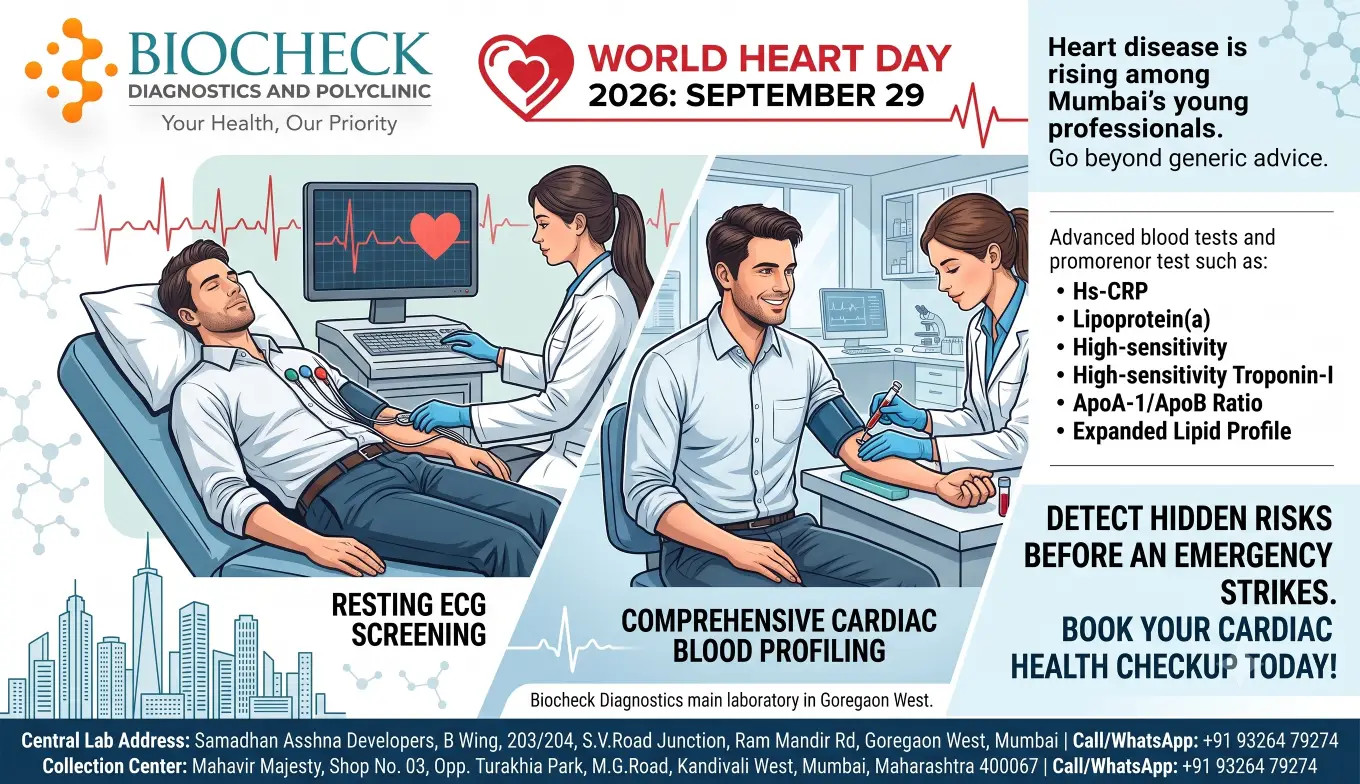
September 29th marks World Heart Day. Every year, this global initiative floods our social media feeds with generic, well-intentioned advice: eat less oil, take the stairs, and try to stress less. While this basic advice is medically sound, it falls dangerously short for the reality of living in Mumbai in 2026.
For the modern urban professional commuting daily from Kandivali or Malad to the massive commercial hubs in Goregaon or Andheri, the Mumbai lifestyle takes a silent, compounding, and aggressive toll on cardiovascular health. We exist in a high-cortisol environment. Relentless deadlines, hours spent inhaling exhaust fumes in stagnant Western Express Highway traffic, disrupted sleep cycles, and a heavy reliance on highly processed, seed-oil-laden restaurant food are the norm.
The clinical result is undeniable: Heart disease is no longer an "old age" issue. Cardiologists across Mumbai are treating massive, fatal myocardial infarctions (heart attacks) in men and women in their early 30s and 40s.
This World Heart Day, it is time to move beyond the generic advice. It is time to treat your cardiovascular health with the same rigorous, data-driven precision you apply to your career. The most dangerous myth in medicine is the belief that "feeling fine" means your heart is healthy. Cardiovascular disease is a silent killer. The first physical symptom of a blocked artery is very often a fatal heart attack.
Here is your ultimate, clinical cardiac checklist to detect hidden risks years before an emergency strikes.
If you ask the average person how to check their heart health, they will point to a standard Lipid Profile. This routine blood test measures your Total Cholesterol, LDL (bad cholesterol), HDL (good cholesterol), and Triglycerides.
While a Lipid Profile is an excellent starting point, modern cardiology has proven that it is highly insufficient for mapping your true risk. A standard LDL test simply measures the weight or concentration of the cholesterol in your blood. However, heart attacks are not caused by the weight of the cholesterol; they are caused by individual cholesterol particles crashing into the walls of your arteries, burrowing inside, and forming hard, calcified plaques.
If you have a massive number of tiny, dense LDL particles, your risk of a plaque rupture is incredibly high—even if the total weight (the standard LDL number) appears perfectly normal on your lab report. To truly assess your risk, you must look deeper.
Preventative longevity medicine relies on advanced biomarkers that look at particle counts, arterial inflammation, and genetic risks. These tests are available right here in the western suburbs at Biocheck Diagnostics.
Apo-B is a specific protein that sits on the surface of every single dangerous, plaque-causing cholesterol particle in your bloodstream. Because there is exactly one Apo-B molecule per particle, measuring your Apo-B level gives your physician an exact, one-to-one count of the destructive vehicles in your blood. It is universally recognized by modern lipidologists as a far superior predictor of cardiovascular risk than standard LDL cholesterol. If your Apo-B is high, you are actively building arterial plaque.
Heart disease is an inflammatory condition. Plaque only builds up when the inner lining of your blood vessels (the endothelium) becomes inflamed and damaged. The hs-CRP test detects the microscopic, smoldering fire of inflammation inside your vascular system. If you have "perfect" cholesterol but a highly elevated hs-CRP, your arteries are under severe distress, and existing plaques are highly unstable and prone to rupturing.
Lp(a) is a highly dangerous, sticky type of cholesterol that dramatically accelerates plaque buildup and blood clotting. Crucially, your Lp(a) levels are determined almost entirely by your genetics. They are not affected by your diet or exercise routine. Many ultra-fit marathon runners suffer sudden heart attacks purely because they inherited high Lp(a). You only need to test this marker once in your lifetime. If it is high, you and your doctor must aggressively manage every other risk factor to compensate.
You cannot evaluate the heart without evaluating your blood sugar. Insulin resistance acts like microscopic sandpaper on your blood vessels, stripping away their protective lining and accelerating atherosclerosis.
HbA1c: This test provides a highly accurate 90-day average of your blood sugar control, bypassing the daily fluctuations of a fasting sugar test.
Fasting Insulin: Years before your HbA1c or fasting sugar turns abnormal, your pancreas will pump out massive amounts of insulin to overcome cellular resistance. A Fasting Insulin test detects this struggle up to a decade before you develop Type 2 Diabetes, allowing you to protect your vascular system before irreversible damage occurs.
Blood tests tell us what is floating in the pipes, but they do not measure the electrical function of the pump itself. A Resting Electrocardiogram (ECG) is a mandatory component of a comprehensive cardiac checkup.
An ECG is a fast, painless, and completely non-invasive test that records the electrical signals traveling through your heart. For urban professionals dealing with high stress and copious amounts of caffeine, a routine ECG is critical for detecting:
Arrhythmias: Irregular heartbeats, palpitations, or atrial fibrillation that can lead to strokes.
Silent Ischemia: Microscopic signs that portions of your heart muscle are not receiving enough oxygen-rich blood, even if you don't feel chest pain.
Ventricular Hypertrophy: A thickening of the heart muscle walls, often caused by untreated high blood pressure.
Important Note on Location: While blood samples for advanced biomarkers can be collected at our Kandivali Collection Center or via Home Collection, specialized diagnostic imaging and cardiac tests like the Resting ECG, Digital X-Rays, and 2D Echo scans must be performed at our Central Laboratory & Polyclinic located at the S.V. Road Junction in Goregaon West.
This September 29th, do not settle for a basic wellness check. At Biocheck Diagnostics, we have curated the ultimate, executive-level health screening designed for the reality of Mumbai life.
The Biocheck Premium Package (₹6,500) is engineered to leave no stone unturned. It includes a complete baseline profile (CBC, Kidney Function, Liver Function, Thyroid), advanced cardiovascular and metabolic markers (hs-CRP, Homocysteine, complete Lipid Profile, HbA1c), plus comprehensive on-site cardiac and pulmonary scans including an ECG, a Chest X-Ray, and a 2D Echo.
You can initiate your Premium Package by booking a fast, hygienic home blood draw for the lab work across Malad, Borivali, or Kandivali, followed by a scheduled, zero-wait-time appointment for your scans at our Goregaon headquarters. Every single report is rigorously verified by our in-house M.D. Pathologists to ensure absolute clinical precision.
Honor World Heart Day by taking your longevity seriously. Understand your Apo-B, map your vascular inflammation, and check your electrical rhythms. Call Biocheck Diagnostics today to book your comprehensive cardiac profiling.
Available Near You
Whether you’re in Malad, Goregaon, Jogeshwari, Andheri or any part of Mumbai, BIOCHECK Diagnostics & Polyclinic is your trusted local centre for ECG and comprehensive ECG services.